A cozy mid-century living room follows a recognizable recipe: low wood furniture on slender legs, soft cream upholstery, a few rust accents, real plants and light that looks golden even at noon. Restraint keeps it from feeling like a period set: clean shapes, natural textures and enough open floor for the room to breathe.
The ideas below start with the furniture shapes that define the style, move through color and texture, and finish with plants, daylight and everyday layers. Most can be tried with things you already own, and each flags the mistake that most often undoes it. You do not need a genuine vintage find or a matching set — just a few consistent choices repeated around the room.
1. Anchor the Room with One Long, Low Wood Piece
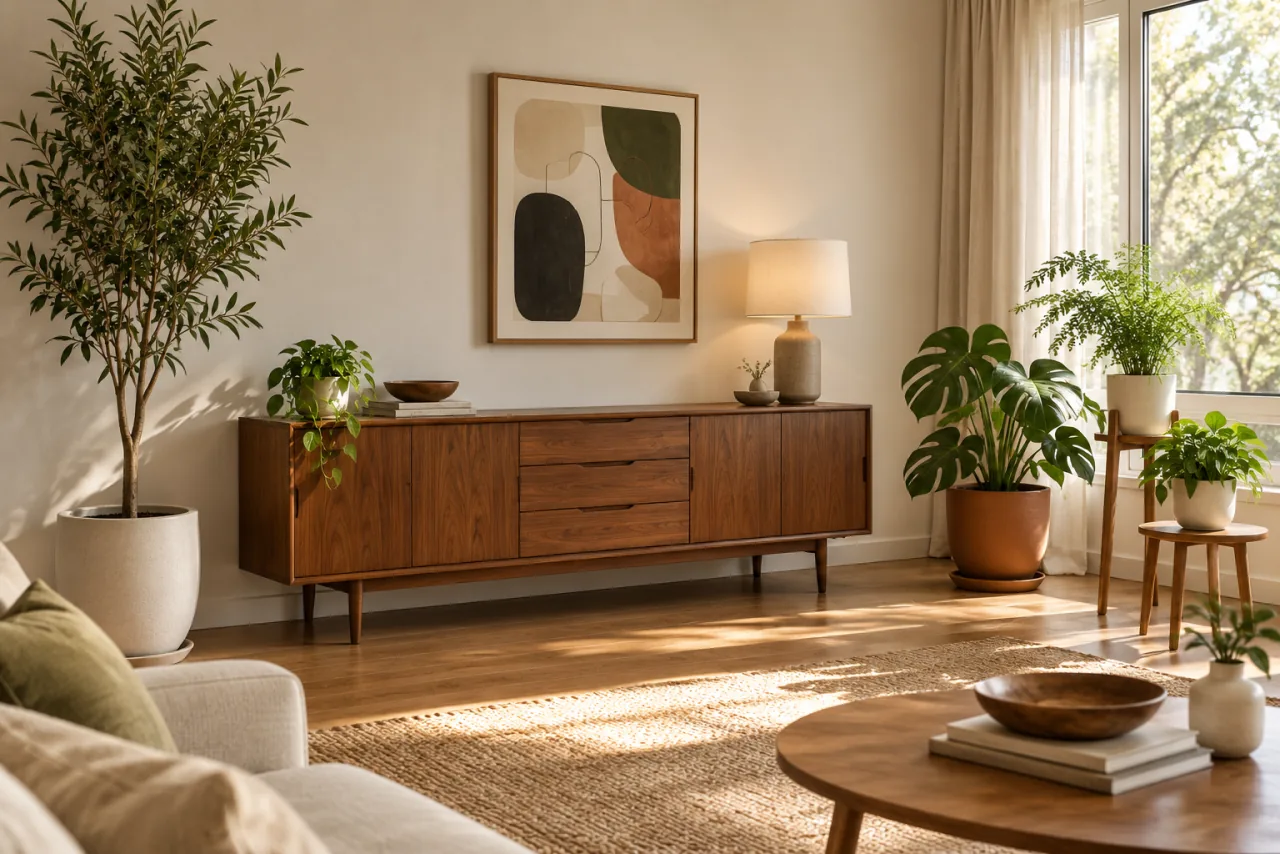
Mid-century rooms read horizontal: a credenza, sideboard or low media cabinet — usually about 24 to 30 inches (61 to 76 cm) tall — draws a line the eye follows across the wall and makes the ceiling feel higher by contrast. Place it on the longest open wall or under a window. Spanning roughly half to two-thirds of the wall looks deliberate.
Try it without buying: Move a low dresser or bookcase from another room onto the main wall for a week.
Watch out: In a narrow room, a depth around 16 inches (41 cm) leaves more walking room than a bulky media console.
2. Choose Pieces Raised on Slim, Tapered Legs
Visible legs are one of the quickest signals of the style. When a cabinet, chair or table sits a few inches off the floor, you see floor beneath it, so the room feels lighter with the same furniture. If the sofa has a solid base, let the coffee table, chair and credenza show their legs.
Try it without buying: Rearrange so the leggiest pieces are what you see first from the doorway.
Watch out: Very slender legs can wobble under heavy pieces; check how they attach, and add felt pads on wood floors.
3. Repeat One Warm Wood Tone at Least Three Times
Warm wood is the backbone here: walnut, teak or any stain with an orange-brown cast. One wood piece reads as an accent; three around the room — credenza, coffee table, chair arms or a frame — read as a plan. Arrange them in a loose triangle. Tones need not match, but keep the undertone orange-brown rather than gray or pink.
Try it without buying: Borrow wooden trays, bowls and stools from other rooms and place them where the living room lacks wood.
Watch out: Identical orange wood on every surface looks like a dated showroom; break it up with cream and plants.
4. Let Cream Textiles Balance the Wood
Wood needs a soft, light partner, and cream is the most forgiving. A cream sofa or slipcover makes the largest surface in the room light, so the wood around it reads rich instead of heavy — warm wood framing pale fabric is the core of the look. Warm cream, ivory or oatmeal suits orange-brown wood better than stark white, which can look bluish beside it. On a sofa of another color, a cream throw and pillow covers shift the balance.
Try it without buying: Drape a pale blanket or flat sheet over the sofa for a day and watch how the wood around it changes.
Watch out: Light upholstery shows wear; with kids or pets, choose washable covers or a deeper oatmeal.
5. Vary the Creams Through Texture, Not Extra Colors
An all-cream sofa can look flat. Varied weaves fix that without adding colors: a nubby bouclé-style pillow, a chunky knit throw, a linen cover and one smoother accent. Each catches side light differently, so the room looks layered rather than plain. Stay within two or three neighboring cream shades.
Try it without buying: Lay every cream textile in the house on the sofa and keep the three with the most different textures.
Watch out: Loopy textures such as bouclé can pill and snag on pet claws; tighter weaves last longer on busy seats.
6. Use Rust in Small, Deliberate Doses
Rust adds warmth that wood alone does not, but here it works as punctuation. Pick two or three spots — a velvet pillow, a ceramic vase, a chair cushion — on a rough diagonal so the eye travels across the room. Rust pressed against orange wood can blur, so keep a cream layer between them.
Try it without buying: Test terracotta pots or burnt-orange books you already own in those spots.
Watch out: Rust curtains, rug and pillows together make the room heavy; keep large surfaces neutral.
7. Limit Pattern to One Graphic Textile
Mid-century design loves graphic pattern — diamonds, stepped lines, simple geometrics. In a cozy version, one piece in black and cream or brown and cream is enough: a geometric pillow or woven throw gives the plain creams something to play against. Keep the scale medium.
Try it without buying: Remove every patterned piece, then add back only the one with the strongest contrast.
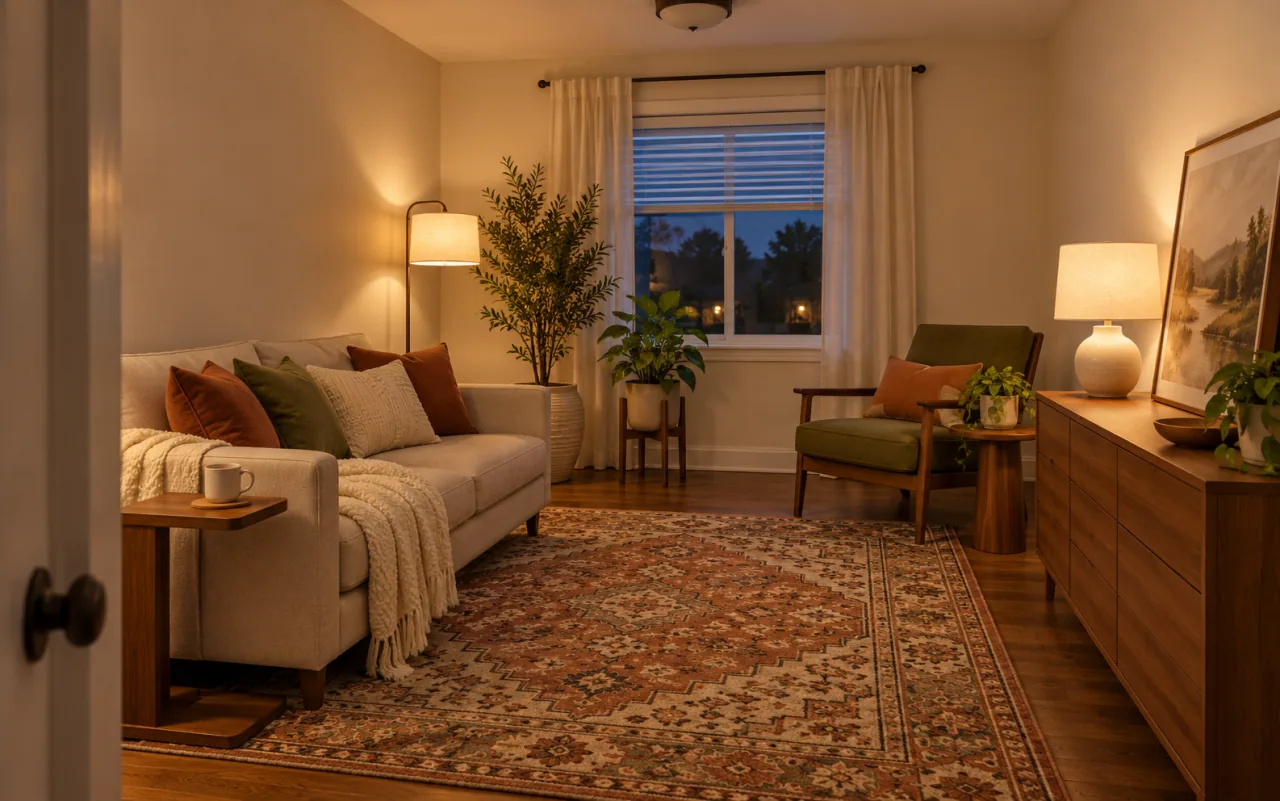
Watch out: A busy rug plus a busy pillow usually compete. If the pillow is graphic, let the rug stay textural.
8. Ground the Seating with a Natural-Fiber Rug
A jute or sisal-look flat weave adds honey-colored texture that bridges wood and cream. Size it so at least the front legs of the sofa and chairs rest on it, tying the seating into one group. In many living rooms that means about 8 by 10 feet (244 by 305 cm), but measure your seating area first.
Try it without buying: Shift your current rug so the front legs of every seat rest on it.
Watch out: Jute is coarse underfoot and can stain when wet; use a rug pad and keep it away from the entry path.
9. Add an Open-Arm Wood Chair Across from the Sofa
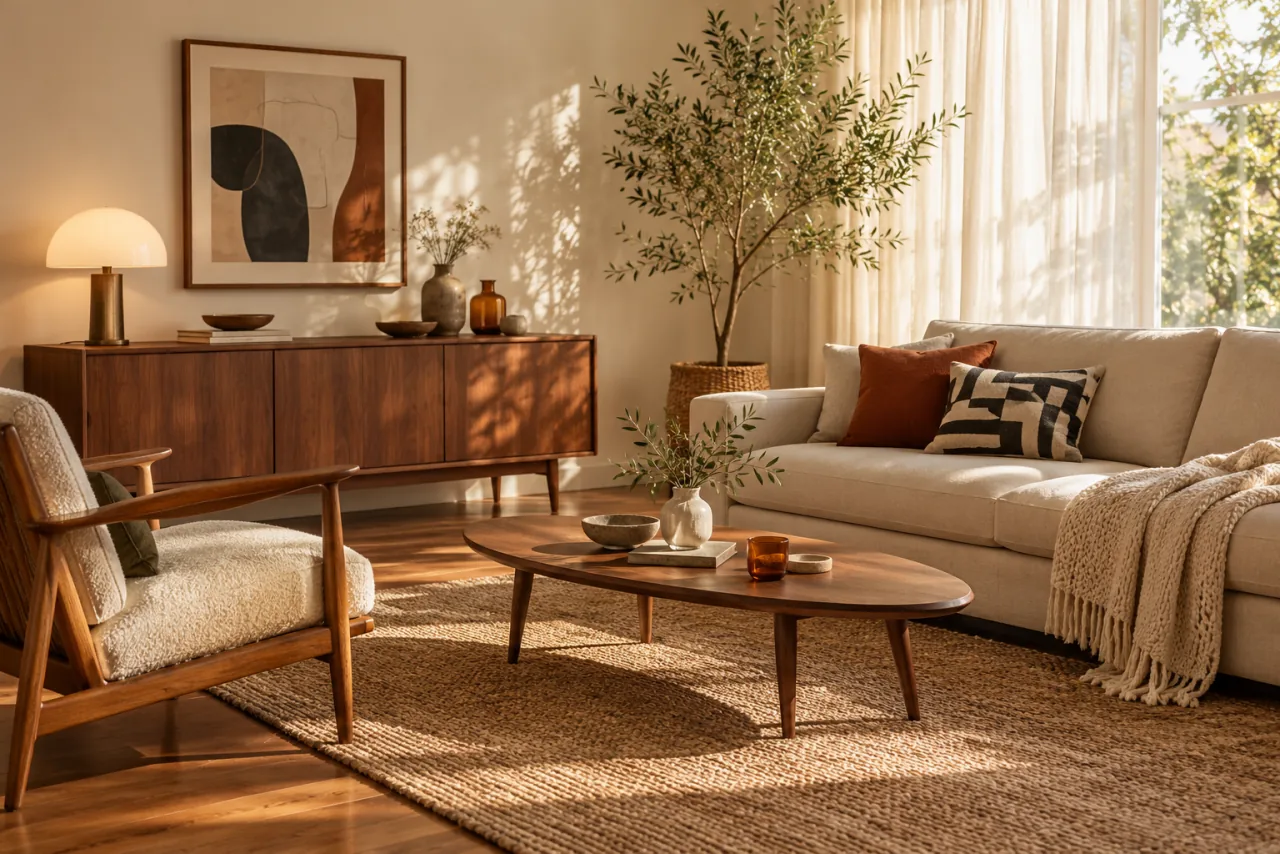
An accent chair with exposed wood arms and a loose cushion is a signature mid-century shape. It brings wood up to seat height, and because you see through the arms and under the seat, it fills a corner without blocking it. Angle it toward the sofa about 3 to 4 feet (91 to 122 cm) away for easy conversation.
Try it without buying: Bring a wooden dining chair in, add a cushion and throw, and test the angle.
Watch out: Low lounge chairs can be hard to get out of; if that matters, look for a seat around 17 to 18 inches (43 to 46 cm) high.
10. Pick a Coffee Table with Soft Edges and the Right Height
Rounded or oval coffee tables suit the style and are easier to walk around. A table level with or slightly below the sofa seat — often about 16 to 18 inches (41 to 46 cm) tall — keeps a mug within reach. Leave roughly 14 to 18 inches (36 to 46 cm) between table and sofa for knees.
Try it without buying: Slide your current table to about 16 inches from the sofa and try it for a few days.
Watch out: A table longer than about two-thirds of the sofa crowds the walkway around it.
11. Place One Tall, Airy Plant Where the Daylight Lands
Low furniture leaves an empty band between the credenza and the ceiling. A tall plant with an open, branching shape fills it without a heavy block, and sun filtered through loose leaves casts soft shadows on the wall — much of why these rooms feel calm. Set it within a few feet of the brightest window, beside the sofa or credenza, clear of walkways. Most tall indoor trees want bright, indirect light; follow the care tag for your plant.
Try it without buying: Move your largest plant beside the brightest window and watch its afternoon shadows.
Watch out: Many ficus and other popular tall plants are listed as toxic to cats and dogs; check the ASPCA plant list if you have pets.
12. Style the Credenza Top as One Small Scene
The low cabinet becomes the focal point when its top holds one clear group: a lamp at one end, stoneware or amber glass in the middle and a small green, such as cuttings rooting in water. Hang one framed piece above, its bottom edge about 6 to 10 inches (15 to 25 cm) over the top. Leave at least a third of the surface clear so the long line still shows.
Try it without buying: Clear the top completely, then add back a lamp, three objects of different heights and one green.
Watch out: Cuttings need fresh water about weekly, and clear glass shows algae fast; amber vessels are more forgiving.
13. Filter Daylight Through Cream Sheers
Soft daylight gives this style its glow. Unlined cream or linen-look sheers diffuse direct sun into even, warm light and soften harsh shadows on wood. Mount the rod partway between window frame and ceiling, and wider than the glass, so panels stack beside the window instead of covering it. Panels that just graze the floor look tailored.
Try it without buying: Push your current curtains fully past the frame at midday and see how much more light reaches the seating.
Watch out: Sheers offer little privacy after dark; pair them with a shade if the room faces the street.
14. Recreate the Golden Glow After Dark
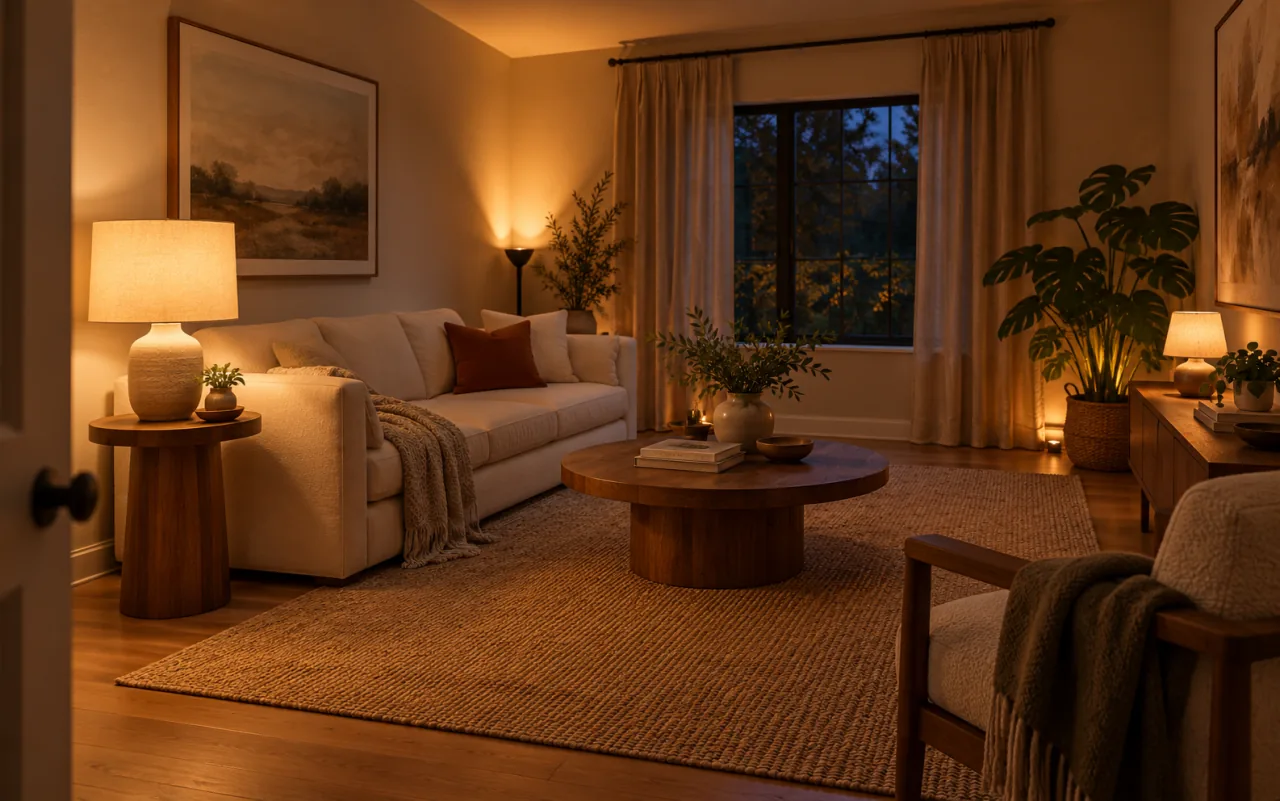
Plan an evening version of that daylight. Two or three lamps placed low — one on the credenza, one beside the sofa — create the warm pools of light this style depends on. Use bulbs labeled around 2700K, often sold as warm white, under opal glass or fabric shades that hide the bulb. Switching off the ceiling fixture keeps wood grain and texture from looking flat.
Try it without buying: Move your warmest bulbs into the living room lamps and spend one evening with lamps only.
Watch out: Check each lamp's label for maximum wattage and bulb type before swapping bulbs.
15. Make Every Layer Earn Its Place
A cozy room still has to handle spills and laundry day. Choose zippered pillow covers you can wash, keep one throw within reach of each main seat and store extras in a lidded basket. A wood tray corrals remotes and coasters so the coffee table stays usable. If a layer makes the room harder to use, it goes.
Try it without buying: Remove any pillow or throw nobody has touched in a month.
Watch out: Too many soft layers trap dust and crowd the seat; two to four pillows on a standard sofa is usually plenty.
A Cozy Mid-Century Living Room Checklist
- Put one long, low wood piece on the main wall.
- Show visible legs on at least three pieces of furniture.
- Repeat one warm wood tone three times around the room.
- Cover the largest upholstered surface in warm cream.
- Mix three cream textures and allow only one graphic pattern.
- Limit rust to two or three small accents placed on a diagonal.
- Size the rug so the front legs of every seat rest on it.
- Place one tall plant near the brightest window and check pet safety.
- Hang sheers high and wide so they stack off the glass.
- Switch to warm bulbs around 2700K and use lamps in the evening.
Common Questions
Can I get a mid-century look without vintage furniture?
Yes. The look comes from low profiles, tapered legs, warm wood and cream fabric more than age. New pieces with those traits plus one secondhand find are enough.
What colors go with warm wood in a mid-century living room?
Warm cream, oatmeal, rust, olive and plant greens are easy partners. Black works in small graphic doses. Cool gray and bright white tend to make orange-brown wood look harsh.
How do I keep a mid-century room from looking dated?
Avoid matching everything, keep pattern to one piece, add living plants and leave open floor.
Does this style work in a small living room?
Yes — low furniture on legs keeps sight lines open. Choose a shallower credenza, a round coffee table and one chair instead of two.