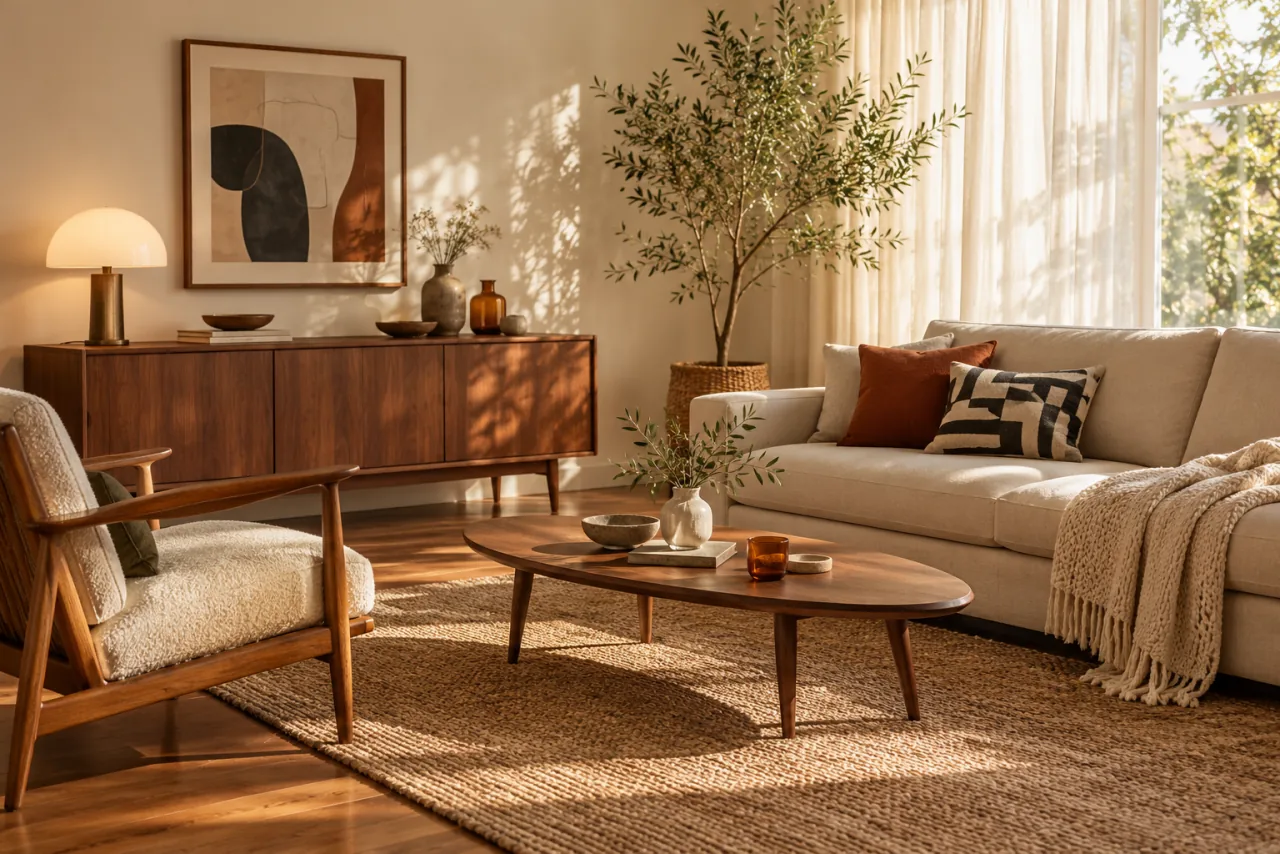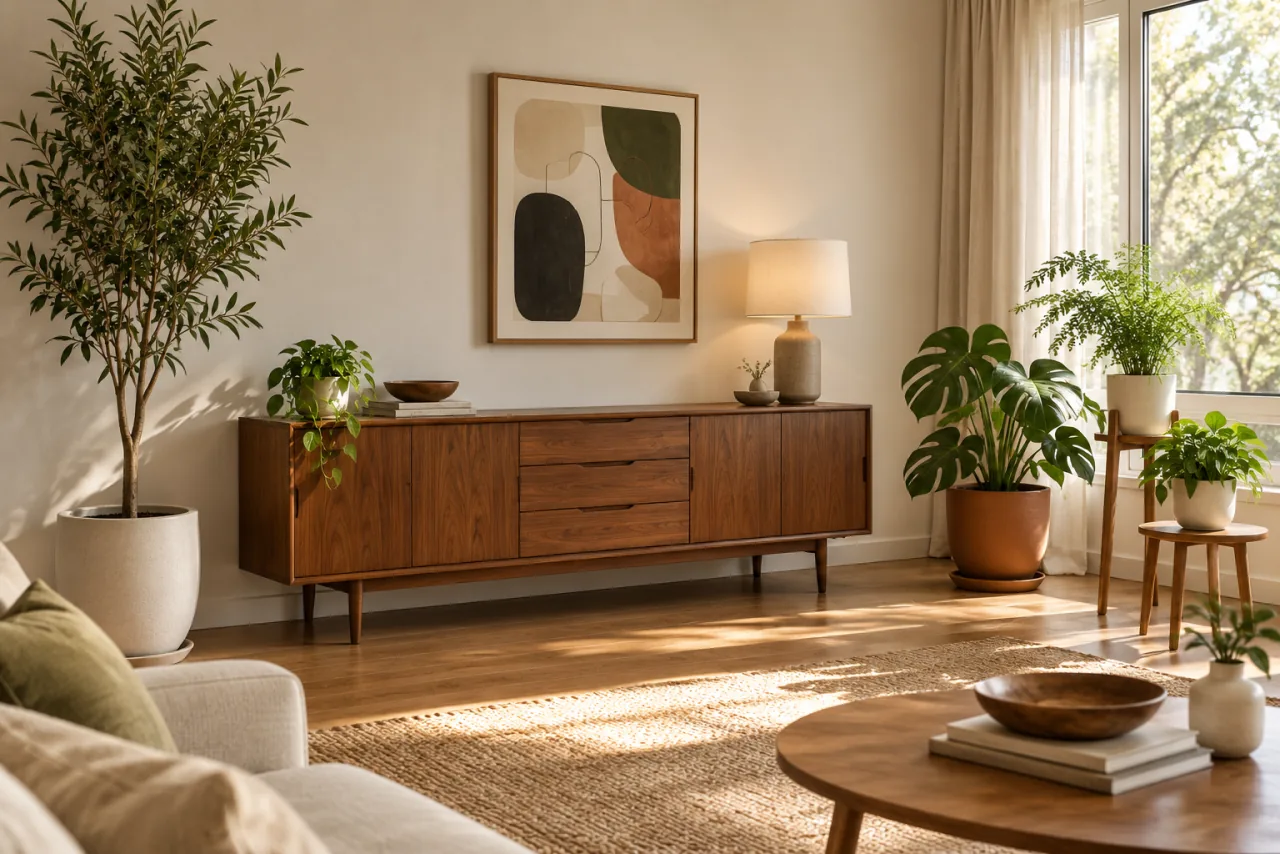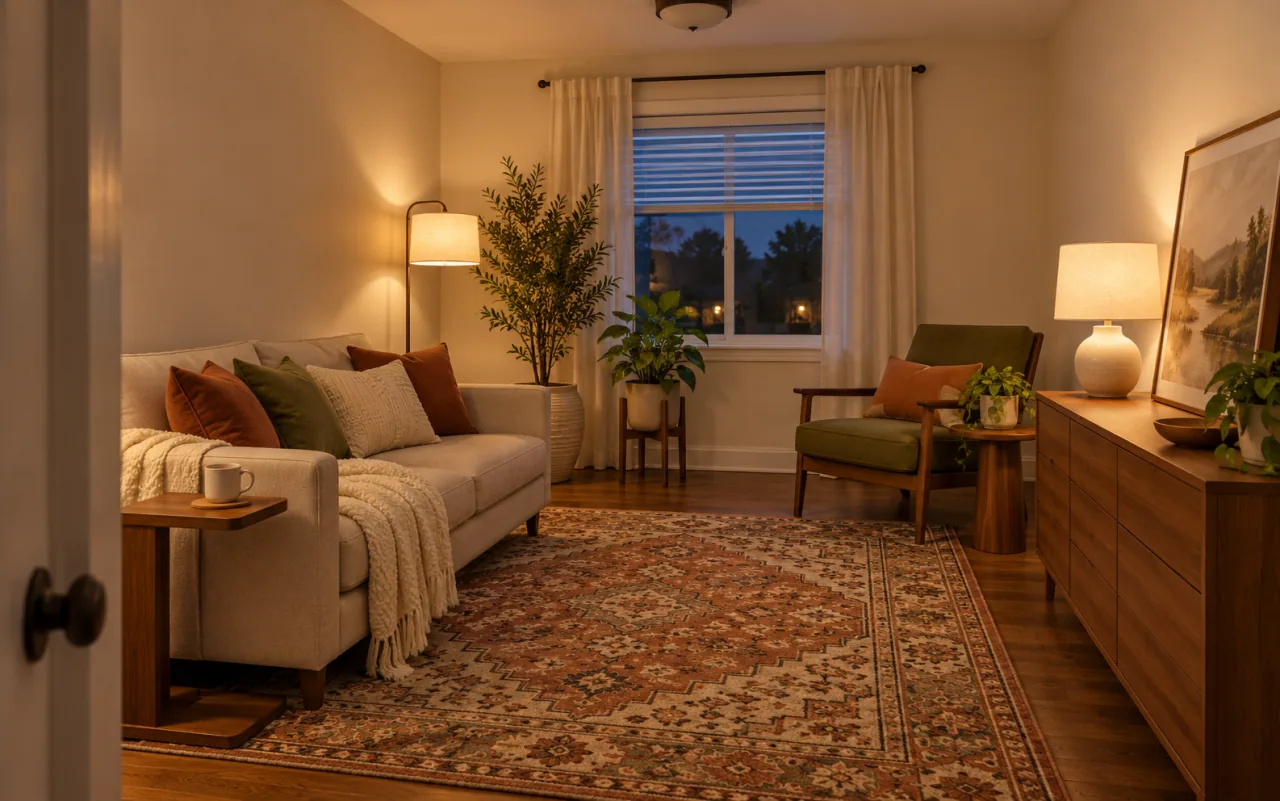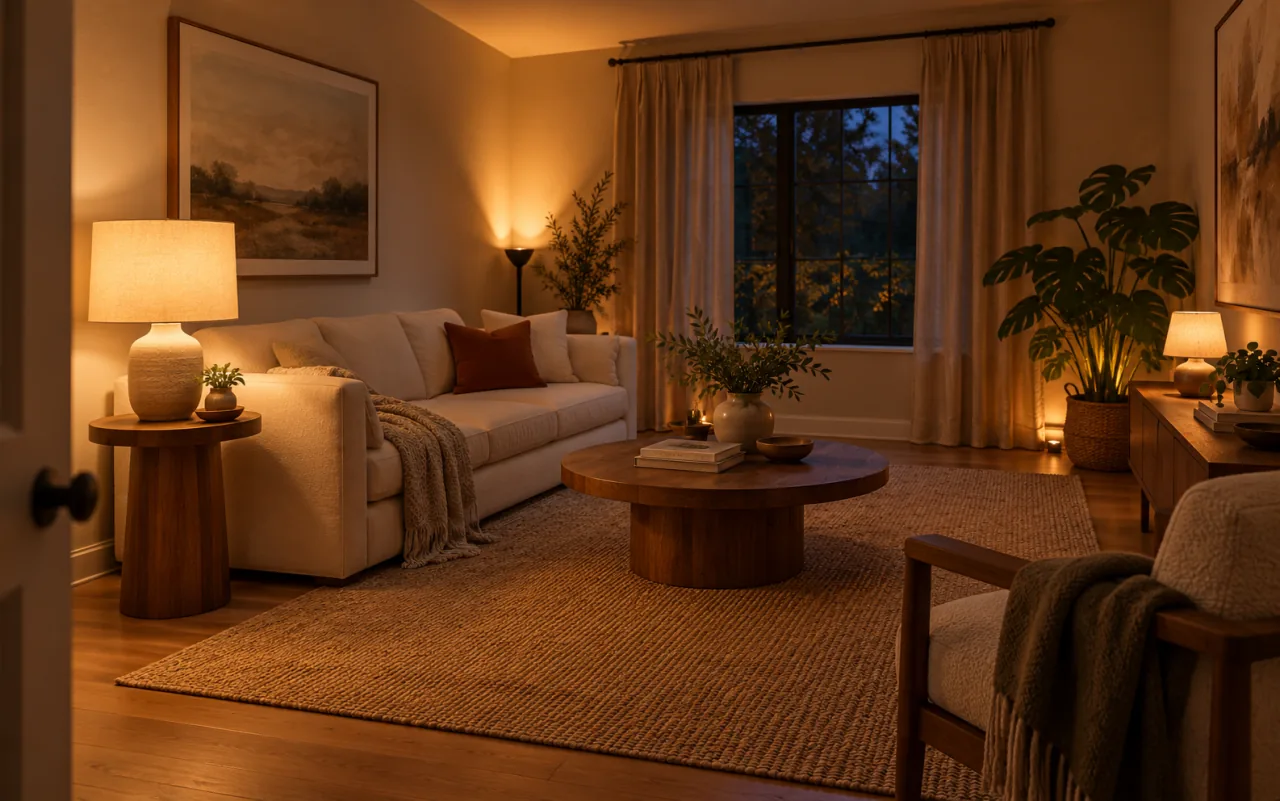
Most living rooms have enough light. What they lack is the right kind in the right places. A single ceiling fixture floods the room evenly, flattens wood and fabric, and makes evenings feel like an office. A warmer room usually has more sources, each doing less: soft light on the walls, a focused lamp where you read, a few small glows that give the room depth.
The 11 ideas below use plug-in lamps, shades, bulbs and simple controls, with no wiring or electrician needed. They cover how to layer light, how big shades should be, which bulb colors feel warm, how to stop glare, and how to plan around the outlets you have. Before buying anything, spend one evening in the room with every light on and notice where your eyes squint or wander.
1. Build Three Layers Instead of One Bright Fixture
Lighting designers often describe three layers. Ambient light is the general glow that lets you move around. Task light is focused where you read, knit or work. Accent light adds small pools that draw the eye to a plant, shelf or piece of art.
A warm living room uses all three at once, from at least three or four sources spread around the room rather than lined up on one wall. Think of a loose triangle: a floor lamp in one corner, a table lamp by the sofa, a small lamp on a shelf or console across the room.
Try it without buying: Gather every lamp in your home into the living room for one evening and place them in a triangle around the seating.
Watch out: Several lamps of identical height in a row look like a showroom. Vary the heights so light sits at different levels.
2. Bounce Ambient Light Off the Walls and Ceiling
Ambient light feels softest when it reaches you indirectly. A floor lamp that throws light upward, or a table lamp with an open-top shade, washes the ceiling and walls and fills the room without a visible hot spot. Light-colored walls reflect more of it; dark walls absorb it, so you may need an extra source.
Place an uplighting lamp in a corner or behind a chair, where the wall and ceiling meet, so the bounce spreads widely.
Try it without buying: Move your tallest lamp into a corner and tilt or remove anything blocking the top of the shade.
Watch out: Uplights near a glossy ceiling can reflect a bright spot. A matte surface or a lower-output bulb keeps the glow even.
3. Place Task Light Beside and Slightly Behind the Seat
Task light should land on the page, not in your eyes. Set a reading lamp beside the chair or sofa arm, slightly behind your shoulder, so the light falls onto your lap. For a typical sofa, the bottom of the shade often lands around 38 to 42 inches (97 to 107 cm) from the floor, close to eye level when seated.
An adjustable arm or a shade that directs light downward helps. Brighter bulbs suit reading, but stay within the lamp's maximum wattage.
Try it without buying: Sit in your reading spot with a book and move the nearest lamp until the page is lit without a shadow from your hand.
Watch out: A reading lamp placed in front of you sends light straight into your eyes. Keep it at your side or slightly behind.
4. Size the Shade to the Lamp and the Table
A shade that is too small looks pinched and exposes the bulb; one too large overwhelms the table. A common rule of thumb is a shade whose height is about two-thirds the height of the lamp base, with a bottom diameter roughly equal to the base's height. The shade should also be narrower than the tabletop so it does not hang over the edge.
On a side table about 24 inches (61 cm) wide, a shade around 14 to 18 inches (36 to 46 cm) across usually looks balanced.
Try it without buying: Swap shades between two lamps you own to see which proportions look right.
Watch out: Replacement shades attach in different ways. Check the fitter type and harp size before buying a new one.
5. Hide the Bulb from Every Seat
Glare comes from seeing the bulb itself, or a bright spot that is much lighter than everything around it. Sit in each seat and look at every lamp. If you can see the bulb under or over the shade, lower the lamp, choose a deeper shade, or add a diffuser.
Frosted bulbs and opal glass shades soften light more than clear bulbs. Lamps beside the sofa work best when the shade bottom sits at or just below seated eye level.
Try it without buying: Swap a clear bulb for a frosted one from another room, or raise or lower a lamp by setting it on a stack of books.
Watch out: Exposed-bulb lamps can look striking, but they need very low-output bulbs to avoid glare in the evening.
6. Choose Shade Material for the Glow You Want
The shade controls how light leaves the lamp. Linen and paper shades glow through, adding soft ambient light. Opaque shades push light up and down, which works for reading but leaves the shade itself dark. The inside color matters too: a white lining reflects more light, while a warm lining tints it slightly.
In a cozy room, translucent shades in cream, oatmeal or warm white keep the glow even across the room.
Try it without buying: Turn on each lamp in the dark and notice which shades glow and which only throw light up and down.
Watch out: Dark or colored fabric shades can cut a lot of light. Check how much you need before choosing a deep tone.
7. Keep Every Bulb in the Warm Range
Color temperature, measured in kelvins (K), sets the mood. Bulbs labeled around 2700K, often called warm white, give a golden light similar to older incandescent bulbs. Around 3000K is still warm but a little crisper. Cooler bulbs, 4000K and above, can make evenings feel clinical.
Keep all bulbs in one room within the same range, since a mix of warm and cool lamps looks patchy. Many packages also list CRI; a higher number generally shows wood and fabric colors more naturally.
Try it without buying: Check the labels on the bulbs you own and move the warmest ones into the living room.
Watch out: Not every bulb fits every lamp. Match the base type, size and maximum wattage printed on the lamp.
8. Add Dimming Without Rewiring
Warmer evening lighting usually means less light, not just warmer bulbs. Plug-in dimmers that sit on the cord or between the plug and the outlet let you lower a lamp without touching the wiring. Some LED bulbs are also sold as dim-to-warm, getting warmer as they dim.
Set the lamps at full brightness in the early evening and lower them later for a calmer room.
Try it without buying: Turn off the ceiling light and one lamp after dinner and leave only the two softest sources on.
Watch out: The bulb must be marked dimmable, and the dimmer must be rated for LED bulbs. Mismatches can cause flicker or buzzing.
9. Light the TV Wall Without Reflections
A dark room with a bright screen strains the eyes, but a lamp in the wrong place reflects on the screen. Place lamps to the sides of the TV, not opposite it, and keep them lower than the screen. A small lamp beside the TV stand softens the contrast between the bright screen and the dark wall around it.
Try it without buying: Turn the TV on, sit in your usual spot and move lamps until no reflections appear.
Watch out: Lamps directly behind the sofa often reflect in the screen. Move them to the side or use a lower-output bulb.
10. Add Small Accent Lights for Depth
Accent lights make a room feel layered. A small lamp on a bookshelf, a plug-in picture light above art, or a compact uplight on the floor behind a large plant all add pools of light at different points. Keep them dimmer than the main lamps so they read as highlights.
Try it without buying: Move a small lamp onto a shelf or console and turn it on as the only light in that corner.
Watch out: Uplights under plants need space for air and should stay away from leaves to avoid heat on foliage. Check the maker's guidance.
11. Plan Lamps Around Your Outlets
Map the outlets before buying lamps. Sketch the room, mark each outlet and decide where lamps can reach without cords crossing walkways. Choose lamp locations within cord reach, and use extension cords rated for the load when you need extra length.
Run cords along baseboards and behind furniture, using cord covers where needed. For a spot with no outlet nearby, a rechargeable cordless lamp is an option, though run times vary.
Try it without buying: Draw the room on paper, mark outlets and plan lamp spots before moving anything.
Watch out: Never run cords under rugs, and avoid plugging power strips into other power strips. Adding outlets is a job for a licensed electrician.
Warmer Evening Lighting Checklist
- Use at least three light sources arranged in a loose triangle.
- Include ambient, task and accent light.
- Add one uplight or open-top shade for soft ambient light.
- Place reading lamps beside and slightly behind the seat.
- Size each shade to its base and table.
- Check every seat for visible bulbs.
- Keep bulbs around 2700K to 3000K in the same room.
- Add plug-in dimmers rated for your bulbs.
- Map outlets and keep cords out of walkways and from under rugs.
Common Questions
What color temperature is best for a living room?
Around 2700K feels warmest; around 3000K is warm but slightly crisper. Keep one range per room.
How many lamps should a living room have?
Usually three to five sources, depending on room size, placed at different heights around the seating.
How do I light a living room without overhead lights?
Combine a floor lamp for ambient light, table lamps for reading and small accent lamps for depth.
How do I stop a lamp from glaring?
Adjust height so the shade covers the bulb from every seat, use frosted bulbs and choose translucent or deeper shades.