An earthy bedroom works when the colors feel as if they came from the same landscape: moss and olive, clay and rust, oat-colored linen, and wood with some warmth in the grain. The catch is that these shades turn muddy quickly when every surface is dark, and they go flat when everything drifts toward beige.
The ideas below focus on decorative layers — bedding, throws, rugs, lamps, art and plants — so you can create a similar feel without new furniture or paint. Each covers what to change, why it works, and the mistake that most often undoes it. Start with the bed, the largest block of color in most bedrooms, and work outward.
1. Choose an Olive with the Right Undertone
Olive and sage are often sold as the same "green," but they behave differently. Olive leans yellow-brown and looks warm next to rust and walnut. Sage leans gray-blue, reads cooler and can make rust look harsh.
Check fabric next to a white sheet in morning and evening light; if the green turns gray at night, it is closer to sage. Pick one family and stay with it, since a sage duvet with olive pillows looks like a near-miss.
Try it without buying: Compare green items you already own against your bedding at night to see which undertone your room favors.
Watch out: Colors on screens are unreliable, so order swatches or check fabric in person when you can.
2. Make Olive Bedding the Anchor
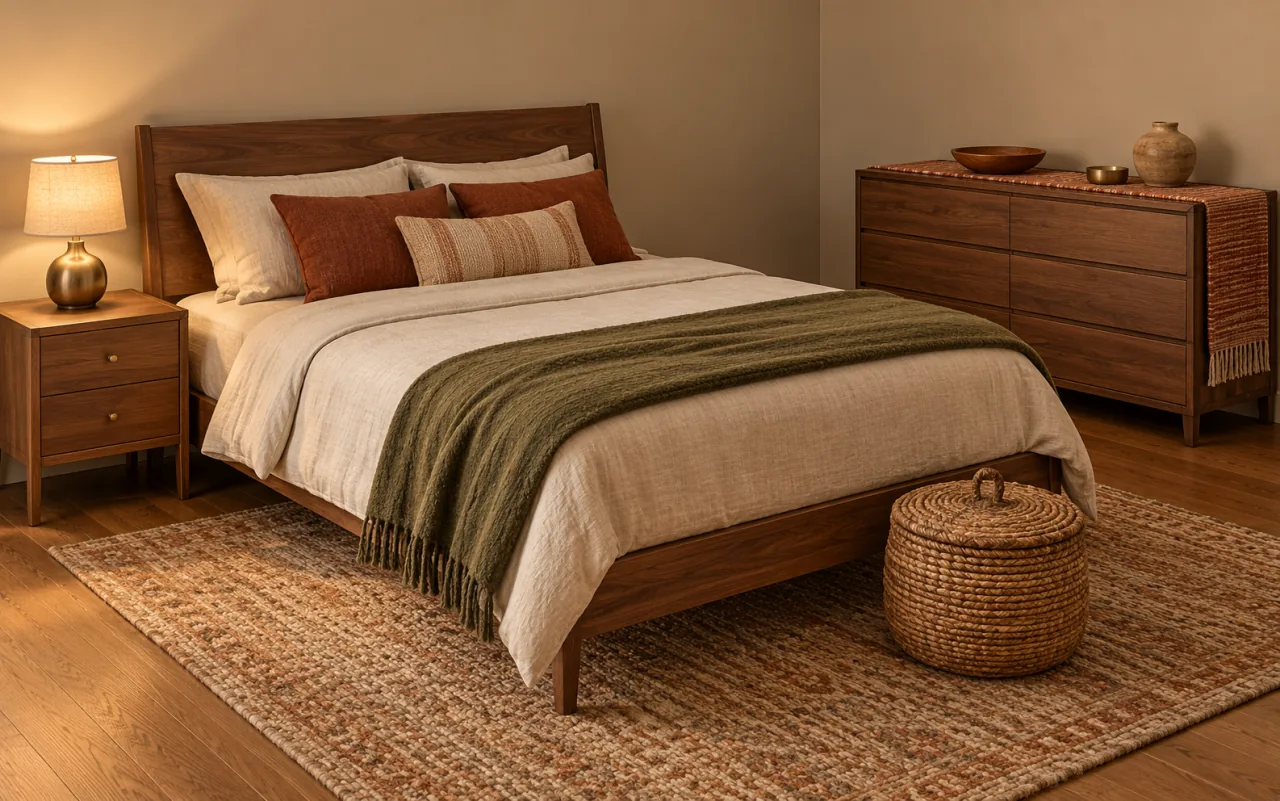
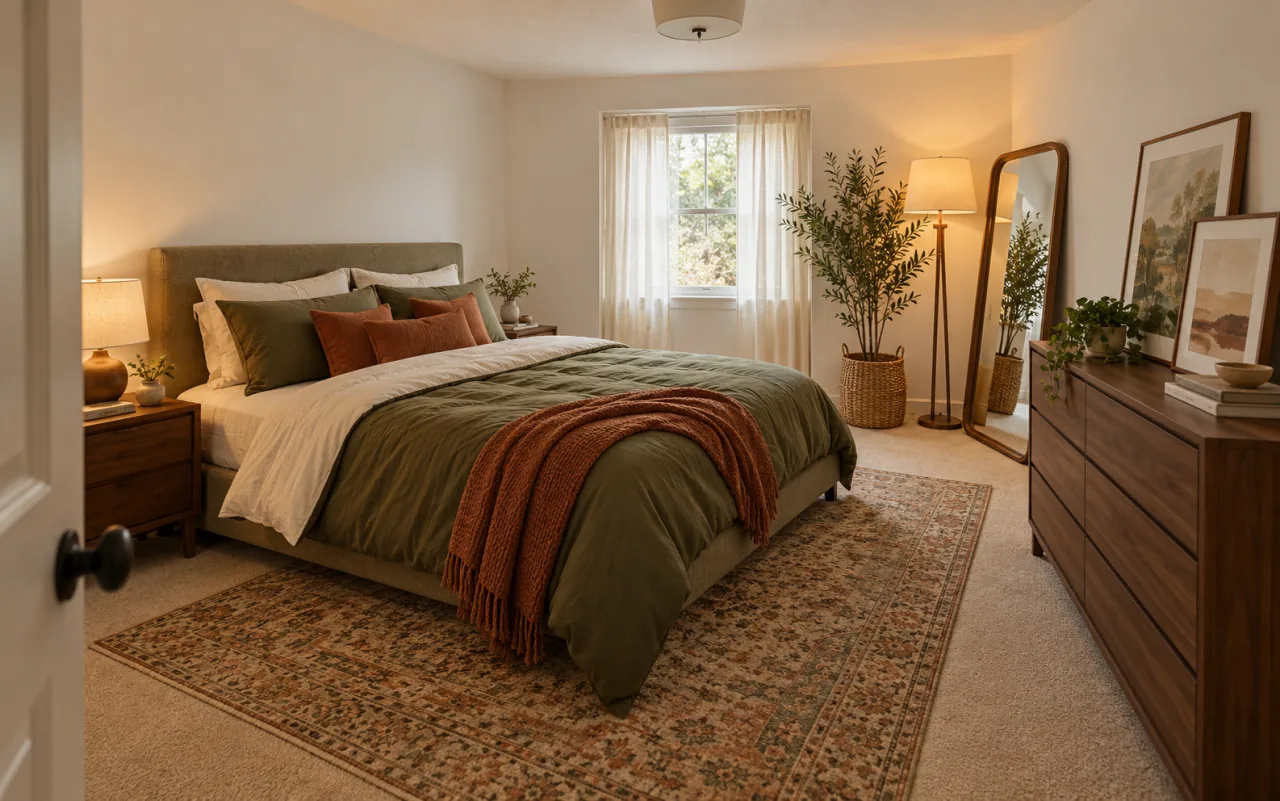
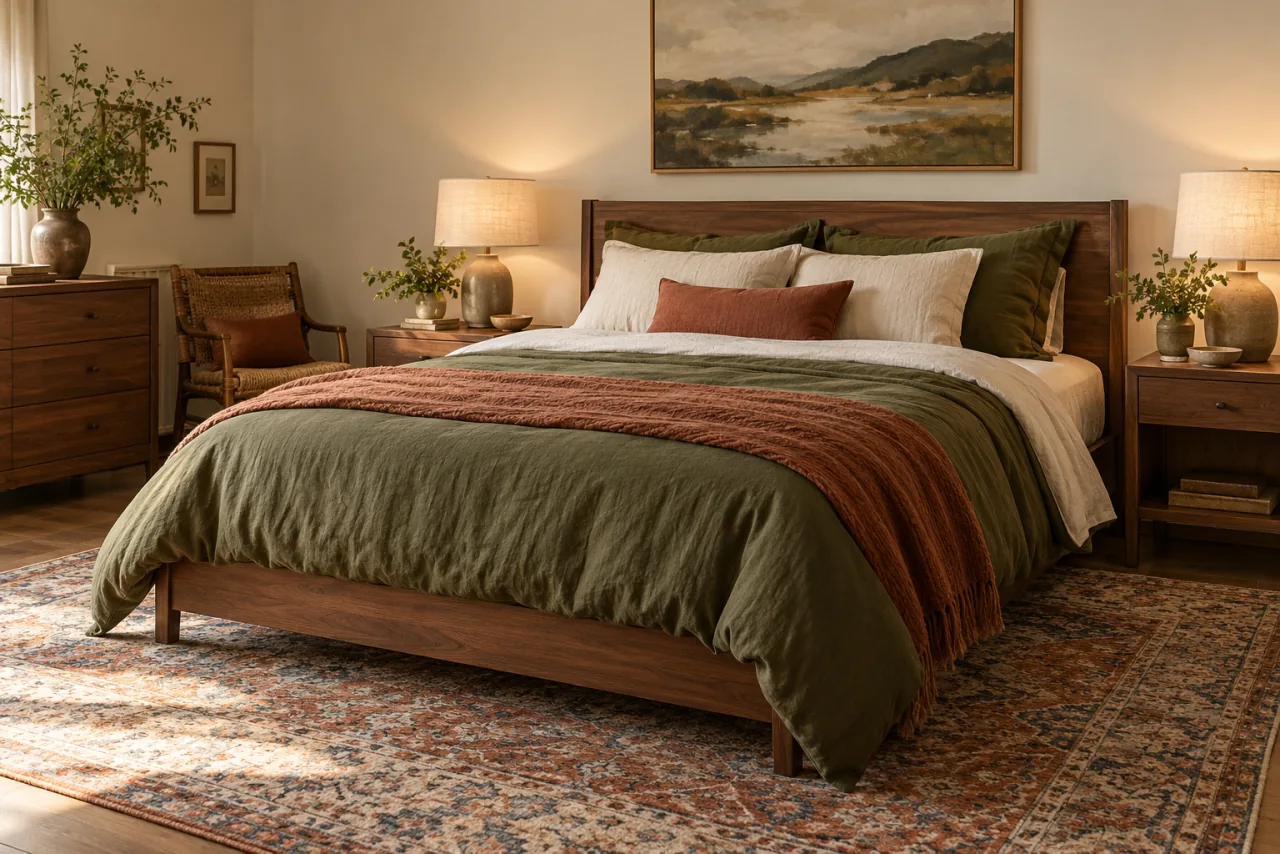
An olive duvet cover or quilt gives the room one large, calm field of color, which is why olive and rust bedding is such a good starting point. Everything else can stay smaller because the bed carries the palette.
Match the cover to your insert's measured size, since "queen" dimensions vary between brands. A washed linen or linen-blend finish hides wrinkles better than crisp sateen.
Try it without buying: Spread any green blanket you own over the bed for a few days to test the color at full scale.
Watch out: A very dark olive in a dim room can look almost brown; choose a mid-tone and let rust supply the depth.
3. Treat Rust as an Accent, Not a Second Main Color
Rust is strong; when it matches olive in quantity, the room looks like a seasonal display. Aim for one large olive area, plenty of cream, and rust in two or three smaller places: a throw, a lumbar pillow, and something near the window or on the wall.
Try it without buying: Collect anything you own in terracotta, copper or burnt orange and test it on the nightstand before deciding what to add.
Watch out: Rust on the bed, curtains, rug and art all at once turns the room orange.
4. Drape a Textured Rust Throw at the Foot of the Bed
A throw is the easiest way to add rust because it is small and easy to wash or swap. Texture matters as much as color: a chunky knit, waffle weave or fringed edge catches light, so the rust looks rich instead of flat.
Fold it lengthwise across the lower third of the bed. A throw of about 50 by 60 inches (127 by 152 cm) suits a full or queen; a king may need a longer blanket.
Try it without buying: Fold any warm-colored blanket you own the same way to test the placement.
Watch out: Loose chunky knits snag on pet claws. A tighter waffle or cotton knit gives a similar effect.
5. Use Cream to Keep the Colors from Getting Muddy
Cream keeps an earthy bedroom from feeling heavy. Cream sheets or pillowcases place a lighter band between the olive and rust, so the whole bed reads softer. Warm cream or ivory suits this palette better than bright white, which looks stark next to muted greens.
Try it without buying: Fold back the top edge of a reversible duvet or light sheet so more of the pale layer shows.
Watch out: Cream bedding against cream walls and a cream rug can wash out; keep one deeper layer close by.
6. Layer the Bed in Light, Mid and Deep Tones
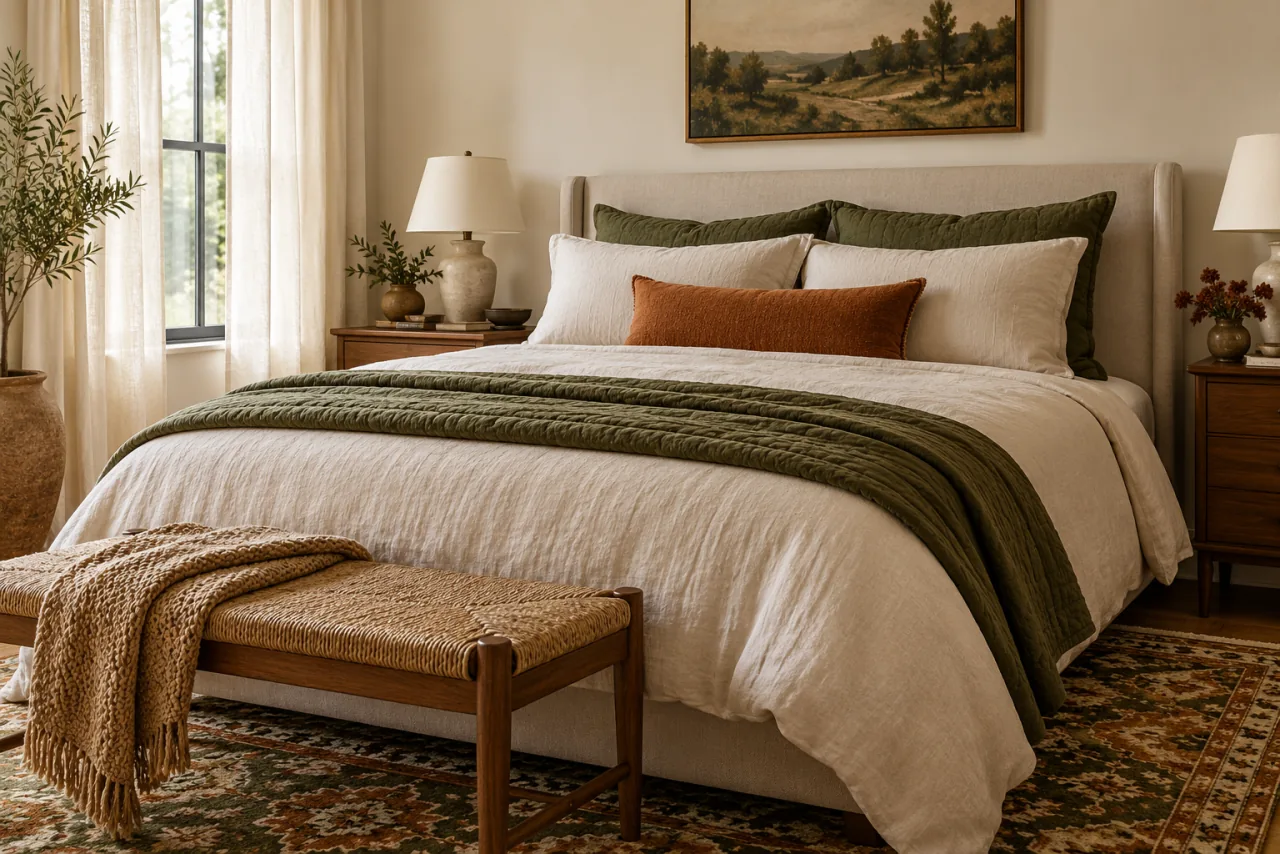
A finished bed usually has three depths of color: light sheets, a deeper main cover and one accent — here, cream sheets, an olive duvet and a rust throw. Fold the duvet back about 12 to 18 inches (30 to 45 cm) from the headboard so the sheet shows as a clear stripe. That small step makes olive and rust bedding look layered rather than like one block of color.
Watch out: Five or six layers look cozy in photos but are hard to remake every morning. Three is realistic.
Try it without buying: Remake the bed tonight with the lightest layer underneath, the deepest in the middle and the accent at the foot.
7. Keep the Pillow Arrangement Simple
A clean lineup shows the color story better than a pile. For a queen, try two cream sleeping pillows, two olive shams in front, and one rust lumbar around 12 by 20 inches (30 by 50 cm) in the center. Mix textures rather than adding colors.
Try it without buying: Remove every decorative pillow, then add them back one at a time until the bed looks finished.
Watch out: A lumbar wider than the space in front of the shams looks crowded.
8. Bring in Walnut-Toned Wood
Mid-tone wood with a warm, slightly orange-brown cast gives this look its mid-century warmth. A headboard, nightstand, frame or lamp base all count, and none needs to be solid walnut; many pieces in this color are veneer or stained, so judge the finish in lamp light.
Try it without buying: Borrow a wooden tray or small stool from another room and place it by the bed.
Watch out: Very red cherry or very yellow pine can fight with olive.
9. Mix Wood Tones on Purpose
Matching sets can make a bedroom feel like a showroom. Keep undertones warm while varying depth: a mid-tone frame, a slightly darker nightstand, a lighter woven basket. Repeat each tone at least twice so it looks intentional.
Watch out: Gray-washed or cool-toned wood usually reads as a mistake in this palette.
Try it without buying: Swap frames and trays between rooms until each wood tone appears twice.
10. Ground the Room with a Vintage-Style Rug
A rug with faded rust, cream, navy or olive in a traditional pattern pulls the palette to the floor. It is where warm wood and vintage textiles meet: the pattern keeps plain wood furniture from looking too new.
For a queen bed, an 8-by-10-foot rug (about 244 by 305 cm) under the lower two-thirds of the bed usually leaves 18 to 24 inches (45 to 60 cm) on each side. In smaller rooms, a runner on each side works too.
Try it without buying: Move a rug you already own and see how much floor shows on each side of the bed.
Watch out: A rug that floats under the bed makes the room look smaller. Use a nonslip pad on hardwood.
11. Add One Vintage Textile with Character
One textile with a sense of age — a kilim pillow, a quilt or an embroidered dresser runner — adds warmth newer pieces often lack. It does not need to be antique; secondhand shops and family closets are good places to look. Keep it to one or two pieces that repeat a palette color, such as a rust thread or olive stripe.
Try it without buying: Look through closets for an old quilt or scarf to fold on the dresser.
Watch out: Check older textiles for moths and loose seams, and ask a cleaner before washing anything delicate.
12. Frame the Window in Rust or Pair Sheers with Color
Curtains give rust a second home away from the bed. Rust or terracotta panels with cream sheers behind them let in soft daylight while adding color at the edges.
Hang the rod about 4 to 6 inches (10 to 15 cm) above the frame and extend it 8 to 12 inches (20 to 30 cm) past each side so panels stack off the glass.
Try it without buying: Remount your existing rod higher and wider to make the window look larger.
Watch out: Panels that cover the glass during the day darken the room and push olive toward brown.
13. Switch to Warm, Layered Lighting
Cool bulbs drain olive to gray and dull rust, while warm light brings out golden tones in wood and fabric. Look for bulbs labeled around 2700K, often sold as "warm white."
Use at least two sources besides the ceiling fixture, such as bedside lamps with linen shades plus a sconce. The bottom of a bedside shade should sit near eye level when you sit up in bed.
Try it without buying: Move the warmest bulbs you own into the bedroom and use only lamps in the evening.
Watch out: Bare bulbs at eye level create glare, so keep shades on bedside lamps.
14. Add Plants for Living Green
Plants add a living green that bedding cannot match. One taller plant near the window plus one small plant on the dresser is usually enough.
Choose for the light you have: tall plants such as fiddle-leaf figs want bright, indirect light, while pothos and snake plants manage lower light. Woven or terracotta pots repeat the earthy tones.
Try it without buying: Move a healthy plant from another room to the bedroom window.
Watch out: Many houseplants are listed as toxic to cats and dogs; check the ASPCA's plant list if you have pets. A good faux plant suits dark corners.
15. Repeat the Palette in Art
Art connects the bed, curtains and plants into one story. A landscape print with olive hills and a rust sun, or a simple botanical study, echoes the palette above the bed.
Hang the bottom of a single piece about 8 to 10 inches (20 to 25 cm) above the headboard, and space a pair about 2 to 3 inches (5 to 8 cm) apart. Wood frames tie art to the furniture.
Try it without buying: Print a landscape photo you took yourself and put it in a frame you already own.
Watch out: Art that is too small above a bed looks lost; aim for roughly two-thirds of the headboard width.
Recreate the Look: A Reader Checklist
Build an earthy bedroom you can recreate in stages, starting with the changes that matter most.
- Pick one olive family (warm olive or cooler sage) and test it in evening light.
- Use olive as the main bedding color and keep rust in two or three smaller spots.
- Add cream sheets or pillowcases so the bed has a light layer.
- Fold the duvet back to show three depths: light, mid and deep.
- Add at least one warm wood piece and repeat each wood tone twice.
- Size the rug so it extends beyond the sides of the bed.
- Swap to warm bulbs around 2700K and use two lamps in the evening.
- Choose plants for your actual light and check pet safety.
- Hang art that repeats at least two palette colors.
Common Questions
What colors go with olive green in a bedroom?
Rust, terracotta, warm cream, camel and mid-tone wood are easy partners. Faded navy works in small amounts, often through a rug. Bright white and cool gray tend to make olive look dull.
Is rust too dark for a small bedroom?
Not when it stays an accent. Keep rust to a throw, a lumbar and one small object, and let cream take up most of the space.
How do I keep an earthy bedroom from looking dated?
Keep lines simple, stick to olive, rust, cream and wood, and avoid a different pattern on every surface. One vintage textile adds character; five look heavy.
Can I create this look in a rental?
Yes. Bedding, rugs, lamps, plants and art all move with you. Lean art on the dresser and use existing curtain brackets or a tension rod.