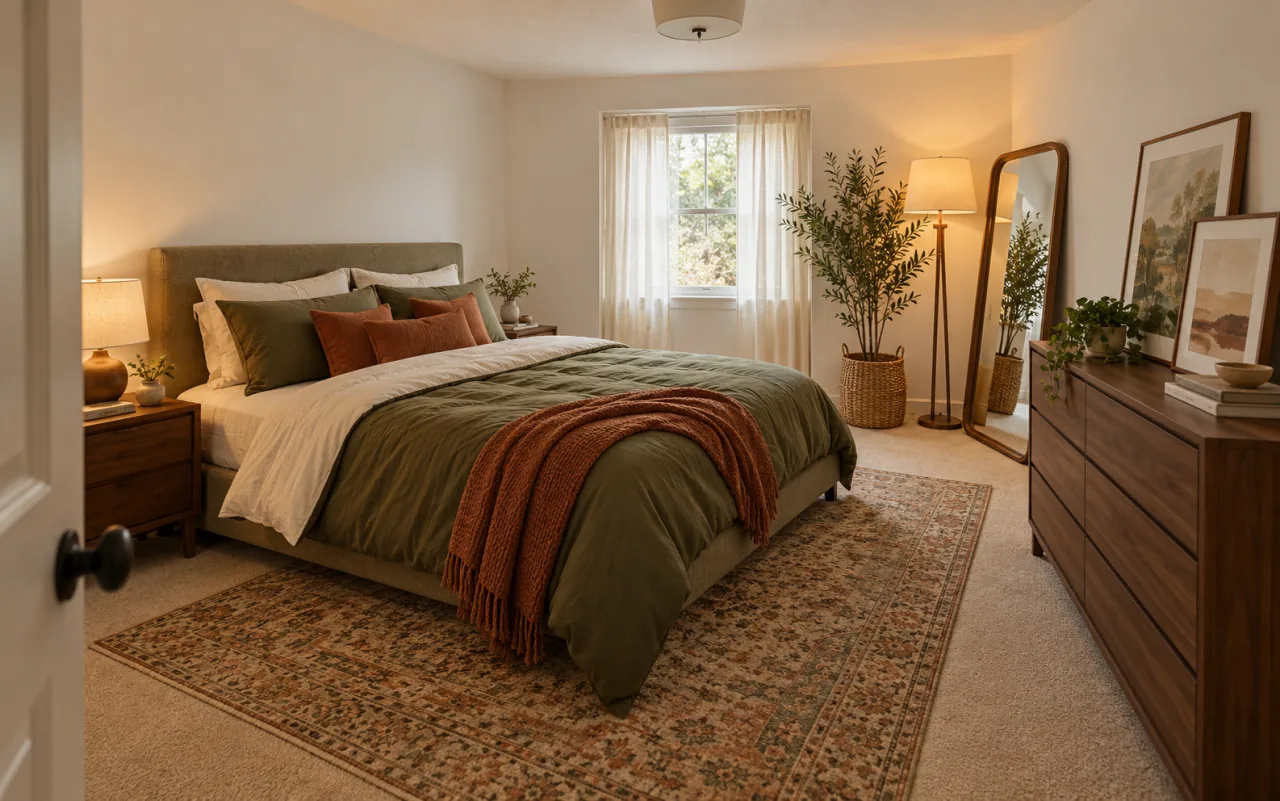
A rented bedroom comes with rules you did not write: walls you cannot paint, fixtures you cannot change and a security deposit riding on how you hang things. That does not mean the room has to stay generic. Most of what makes a bedroom feel warm — bedding, lamps, rugs, mirrors and art — can stand, lean or rest on furniture instead of attaching to the walls.
The 13 ideas below start with the lease, then focus on freestanding pieces and textiles that change easily and move with you. Where a product does touch the wall, you will find what to check first. The palette leans warm and earthy — olive, rust, cream and wood — but every approach works with your own colors.
1. Read the Lease, Then Ask in Writing
Before buying anything that attaches to a wall, window or ceiling, reread the alterations section of your lease. Some leases allow small nail holes; others ban any fastener, paint or fixture change. Rules also vary by building and by local law, so do not assume what a friend's lease allowed applies to yours.
If something is unclear, email the landlord or property manager with a specific question, such as "May I hang two framed prints with small nails?" A written reply protects you at move-out.
Try it without buying: Make a list of every change you are considering and send the questions in one message.
Watch out: A verbal yes from a maintenance worker may not count. Keep approvals in writing.
2. Keep a Restore Kit for Anything You Swap
Some changes are allowed as long as you put things back: a lampshade, a curtain rod, a closet door handle. Store every original part in a labeled bag or box, and take dated photos of walls, floors and fixtures when you move in and again before any change.
This makes it easy to restore the room and gives you a clear record if questions come up when you move out.
Try it without buying: Photograph each wall and fixture in the bedroom today, even if you moved in months ago.
Watch out: Small screws and brackets go missing quickly. Tape them to the inside of the box lid as soon as you remove them.
3. Design Around the Wall Color You Cannot Change
Rental walls are often white, beige or a cool greige. Instead of fighting them, choose textiles that bridge the wall and your palette. Warm cream bedding softens stark white walls; olive and rust look richer against beige; on cool gray walls, add more cream and wood so rust does not look harsh.
Treat the wall as one more neutral and let fabric and wood carry the color.
Try it without buying: Hold your bedding, a throw and a wood object against the wall in morning and evening light to see which combinations look best.
Watch out: Peel-and-stick wallpaper and paint are not automatically allowed. Check your lease and ask first; removal can damage some surfaces.
4. Use a Frame-Mounted or Freestanding Headboard
A headboard makes a bed look finished, and it does not need to touch the wall. Many bed frames have brackets or bolt holes for a headboard that attaches to the frame itself. Freestanding headboards with their own legs are another option. In both cases, check the hole spacing and bracket type on your frame before choosing one.
An upholstered headboard in olive, rust or oatmeal adds color behind the pillows.
Try it without buying: Stack two large pillows upright against the wall behind your sleeping pillows to test the effect of a taller, softer backdrop.
Watch out: A headboard that is not secured can knock against the wall at night. Add felt pads where it touches.
5. Lean a Floor Mirror Instead of Hanging One
A full-length mirror leaned against the wall is one of the most useful freestanding bedroom accents. It reflects window light, makes small rooms feel deeper and needs no holes. A wood frame repeats the warm wood in the room.
Lean it at a gentle angle with the base a few inches (about 5 to 10 cm) out from the wall, on a rug or nonslip pad so it does not slide.
Try it without buying: Move an existing mirror from a closet door or hallway and lean it opposite the window.
Watch out: Large mirrors are heavy and can tip if bumped. Place it out of walkways, use any anti-tip hardware the maker provides, and take extra care with children and pets.
6. Lean Art on the Dresser and Nightstands
Art does not have to hang to make a room personal. Lean one larger framed piece on the dresser, then overlap a smaller frame in front of it slightly off-center. Repeat the idea on a nightstand with a single small print. Layered leaning art looks relaxed and lets you rearrange without patching holes.
Choose prints with olive, rust or sand tones to link them to the bedding.
Try it without buying: Gather framed photos from around your home and test them leaning on the dresser before deciding what to add.
Watch out: Glass-fronted frames can slide off a smooth top. Use a small piece of nonslip shelf liner under the bottom edge.
7. Let Plug-In Lamps Replace the Ceiling Light
Many rentals have a single overhead fixture that makes a bedroom feel flat. Plug-in table and floor lamps fix that without electrical work. Use two or three warm lamps at different heights, with bulbs around 2700K, and leave the ceiling light for cleaning and packing days.
Route cords along the baseboard and behind furniture so they are not in walking paths.
Try it without buying: Move lamps from other rooms into the bedroom for one evening and turn off the overhead light.
Watch out: Do not run cords under rugs, where they can overheat or be damaged unseen. Check each lamp's maximum bulb wattage.
8. Flip a Reversible Duvet Cover
A reversible duvet cover gives you two looks for one storage spot. Choose one with a deeper side, such as olive or rust, and a lighter side in cream or oatmeal. Use the darker side in cooler months and flip it when you want the room to feel lighter.
This is one of the easiest reversible bedding changes because it changes the largest block of color in the room in a few minutes.
Try it without buying: Turn your current duvet cover inside out or swap in a different quilt for a week to see how a color shift changes the room.
Watch out: Some reversible covers have a contrast color that shows at the edges. Make sure you like both sides together.
9. Change Pillow Covers, Keep the Inserts
Pillow inserts are bulky to store; covers fold flat. Buy covers in sizes that match inserts you already own and rotate them with the seasons, such as rust and olive in fall, cream and linen in spring. Changing two or three covers updates the bed without adding new storage needs.
Zippered covers are easier to swap and wash than envelope backs.
Try it without buying: Measure your inserts and write the sizes on a note in your phone so you buy the right covers later.
Watch out: A cover slightly smaller than the insert looks plump; one larger looks limp. Many people size covers to match or about an inch (2.5 cm) smaller.
10. Lay a Rug Over the Carpet or Floor You Have
Wall-to-wall carpet in landlord beige is common, and you can layer over it. A flat-weave or low-pile rug in a vintage-style pattern adds color and defines the bed area. On carpet, use a rug-to-carpet gripper pad to reduce creeping; on hardwood or vinyl, use a nonslip pad.
Position the rug so it extends past the sides of the bed where your feet land in the morning.
Try it without buying: Move a rug from another room into the bedroom and test its position under the lower part of the bed.
Watch out: Thick rugs on top of carpet bunch up and can become a tripping hazard. Keep pile low.
11. Hang Curtains Without Drilling New Holes
Curtains soften a rental window, and there are several ways to hang them without new holes. Reuse existing brackets if the lease allows. Inside a window recess, a tension rod holds lightweight panels. No-drill brackets that clamp onto some window frames are another option, but they only fit certain frame types.
Choose cream sheers or rust panels that are light enough for the hardware.
Try it without buying: Check whether your window already has brackets or a rod you can reuse.
Watch out: Tension rods sag under heavy blackout panels, and clamp-on brackets can scratch frames. Check the weight rating and the lease.
12. Know What Removable Hooks Can and Cannot Do
Adhesive hooks and strips are useful for lightweight items, such as a robe or a small frame, but they are not guaranteed to be damage-free. Results depend on the wall surface and the weight. Check the package weight rating, the list of surfaces it suits and your lease, and test on a hidden spot first. Many makers advise waiting about a week after painting before applying.
Remove them exactly as the instructions say, usually by stretching the tab slowly straight down along the wall.
Try it without buying: Use an over-the-door hook on the bedroom or closet door instead.
Watch out: Textured walls, wallpaper and some paints can peel when a strip is removed.
13. Add Height with Freestanding Pieces, Safely
A bedroom of low pieces can feel flat. Freestanding height adds interest: a tall plant in a woven basket, a floor lamp or a leaning ladder rack for blankets. Choose pieces that are stable on their own, with a wide base.
Many tall bookcases and dressers come with anti-tip hardware meant to be anchored to the wall. If you cannot anchor, choose lower, wider furniture instead of skipping the safety step.
Try it without buying: Move a tall plant or floor lamp from another room into the corner near the window.
Watch out: Many popular houseplants are listed as toxic to cats and dogs. Check the ASPCA plant list if you have pets.
A Bedroom for Renters: Checklist
- Read the alterations section of the lease and ask questions in writing.
- Photograph the room and store any original parts you remove.
- Choose bedding that bridges your wall color.
- Use a frame-mounted or freestanding headboard.
- Lean a mirror and art instead of hanging them.
- Light the room with plug-in lamps and keep cords out of paths.
- Use reversible bedding and swap pillow covers.
- Layer a low-pile rug with the right pad.
- Check weight ratings and surfaces for any removable product.
Common Questions
Can I put nails in the wall of a rental?
It depends on your lease and local rules. Some allow small nail holes; others do not. Ask your landlord in writing.
Are removable hooks really damage-free?
Not always. Results depend on the wall surface, paint and weight. Check the package rating, test on a hidden spot and remove as instructed.
How do I make a rental bedroom cozy without painting?
Focus on bedding, rugs, lamps and leaning art. These change the room the most and move with you.
Can I use a headboard without mounting it to the wall?
Yes. Choose one that attaches to the bed frame or a freestanding style, and check your frame's brackets first.