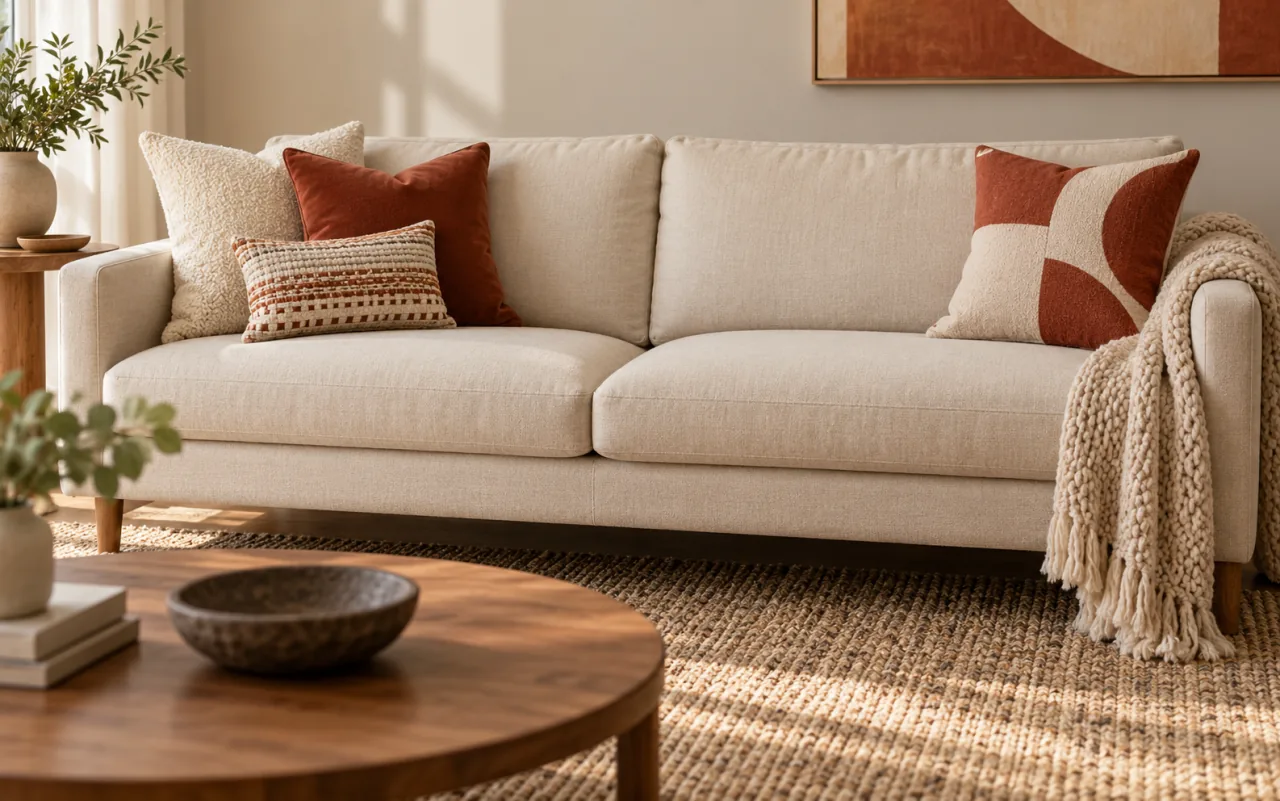
Throw pillows are the easiest way to change how a sofa looks, and also the easiest way to overdo it. Too few and a sofa looks bare; too many and nobody can sit down without first moving a pile to the floor. Flat, underfilled covers and pillows in five unrelated colors are just as common.
The ideas below work with the sofa you already have. They start with practical numbers, such as how many pillows suit your sofa's length and which insert size fills a cover, then move to texture, pattern, color and arrangement. Most of them can be tried by rearranging pillows already in your home before you buy a single new cover.
1. Match the Pillow Count to the Sofa's Length
A practical pillow count leaves room to sit. As a starting point, a sofa about 72 inches (183 cm) long usually looks finished with three or four pillows, while one around 84 inches (213 cm) can take four or five. A loveseat often needs only two, and an armchair one.
Think in seats: each person sitting down should have a full seat cushion without moving a pillow. If the sofa is used daily for naps or movie nights, start at the low end.
Try it without buying: Gather every throw pillow in your home onto the sofa, then remove them one at a time until two people can sit comfortably.
Watch out: Deep sofas can hide too few pillows, so count by seat depth as well as length; a shallow sofa with many pillows leaves almost no seat.
2. Size Inserts Slightly Larger Than the Cover
A pillow looks full when the insert is a little bigger than the cover. A common guide is to go up about 2 inches (5 cm): a 20-inch (51 cm) cover with a 22-inch (56 cm) insert. With firm polyester inserts, going up 1 inch is often enough.
Measure covers seam to seam while they lie flat, since labeled sizes vary. Feather or down blends compress into corners and hold a soft dent, while polyester fills rebound and keep a rounder shape.
Try it without buying: Swap inserts between pillows you own to see which covers look underfilled and which size fills them best.
Watch out: Going up more than about 2 inches can strain zippers and seams. Check the cover's closure and care label before overstuffing.
3. Choose Pillow Size by the Sofa's Back and Depth
Pillows should relate to the sofa's proportions. On a low-back or shallow sofa, 18-inch (46 cm) pillows keep the back line clean. A standard sofa usually suits 20- or 22-inch (51 or 56 cm) pillows, and a deep sofa can take 24-inch (61 cm) squares at the back.
As a quick check, the back row should rise only a little above the sofa back, if at all, when the pillows stand upright.
Try it without buying: Stand your largest pillow against the sofa back and step across the room. If it towers over the frame or disappears, change the size you plan to use there.
Watch out: Oversized squares on a shallow sofa push sitters forward onto the front edge of the seat.
4. Mix Pillow Textures
When colors are calm, texture does the work. Aim for at least three surfaces in one arrangement: something smooth, such as cotton or velvet; something nubby, such as bouclé or slub linen; and something with depth, such as a chunky knit or woven texture.
Texture also makes cream and warm neutrals look intentional. A sofa with four smooth cream pillows looks unfinished, while the same colors in velvet, bouclé and knit look layered.
Try it without buying: Line up pillows you own by texture rather than color, and pick one from each group.
Watch out: Loose knits and loop-pile bouclé snag on pet claws, watches and zippers. Keep those textures at the back of the arrangement or choose tighter weaves.
5. Balance Patterns and Solids
A useful ratio is about two solids for every pattern. On a sofa with four pillows, try two solids and two patterns, or three solids and one pattern. Place patterns next to solids rather than side by side, so each one reads clearly.
Solids give the eye a rest and let a single pattern stand out. They also make it easier to change the look later by swapping one patterned cover.
Try it without buying: Turn patterned covers inside out or swap them for plain ones to see whether the sofa feels calmer with fewer patterns.
Watch out: All solids in one color can look flat; all patterns look busy. If you avoid pattern entirely, lean harder on texture.
6. Vary the Scale of Each Pattern
Two patterns of the same size compete. Pair one larger-scale pattern, such as a wide geometric or a big botanical, with a smaller one, like a tight stripe, a small check or a woven dot. Put the large pattern on the larger pillow so the scale feels natural.
Keep patterns in the same color family. A rust-and-cream geometric pairs easily with a cream-and-brown stripe because both share at least one color.
Try it without buying: Squint at your arrangement. If two patterns blur together, swap one for a smaller or larger print.
Watch out: Very small, high-contrast prints can look busy at a distance, especially on a sofa viewed from across the room.
7. Link Pillow Colors to the Rest of the Room
Pillows look chosen rather than bought when their colors appear elsewhere in the room. Pull one color from the rug, one from art or a plant pot, and let the wood tones guide a warm accent, such as rust or caramel.
A simple rule is to repeat each pillow color at least once more in the room, ideally across from the sofa so the color moves around the space.
Try it without buying: Hold each pillow up to the rug, art and curtains. Keep the ones that clearly repeat a color you already have.
Watch out: Matching pillows exactly to the sofa fabric makes them vanish. Go a shade lighter or darker, or change texture.
8. Arrange from the Back Forward, Large to Small
Start with the largest squares against the back or arms, then layer smaller squares or a lumbar in front. For a symmetrical look, mirror a pair at each end. For a relaxed, asymmetrical look, place three pillows on one end and one pillow plus a throw on the other.
A light chop on top of feather-blend pillows makes them sit softly; firm polyester pillows usually look better smoothed and upright.
Try it without buying: Try both a symmetrical and an asymmetrical arrangement with the same pillows and leave each for a day.
Watch out: Pillows placed in the middle seats get flattened and tossed aside. Keep most of them toward the arms.
9. Use a Lumbar to Finish Long or Deep Sofas
A lumbar pillow is the finishing layer. On a standard sofa, one about 12 by 20 inches (30 by 51 cm) set in front of a square at one end adds variety without crowding. On a loveseat or a deep sofa, a long lumbar around 14 by 36 inches (36 by 91 cm) can span the back on its own.
Lumbars are a good place for a stronger color or pattern because only a small amount shows.
Try it without buying: Fold a rectangular pillow or small throw lengthwise and place it in front of a square to test the shape.
Watch out: A lumbar with an underfilled insert slumps in the middle; size it up just as you would a square.
10. Treat the Throw as Part of the Arrangement
A throw balances an asymmetrical layout. Drape it over the arm on the side with fewer pillows, or fold it in thirds over one seat back. The throw should share at least one color or texture with the pillows so the end of the sofa looks connected.
A throw around 50 by 60 inches (127 by 152 cm) is a common size for draping without trailing on the floor.
Try it without buying: Take a blanket from the bedroom and test it on each end of the sofa.
Watch out: A throw that pools on the floor gets stepped on and collects dust. Fold it shorter or keep it on the seat.
11. Style a Cozy Sofa with Fewer Layers
A cozy sofa with fewer layers can feel more inviting than a crowded one, because it looks ready to use. Keep the inserts you like and treat covers as the changeable part: two or three rotating sets in the same sizes let you shift between lighter and warmer looks without storing more pillows.
Keep spare covers folded flat in a lidded basket or drawer. Choose zippered, removable covers where possible, and follow each care label before washing.
Try it without buying: Remove one pillow from your current arrangement and live with it for a week. Many sofas look better with one fewer.
Watch out: Storing extra inserts compressed for months can flatten them. Fluff them in a dryer only if the care label allows it.
Sofa Pillow Styling Checklist
- Count seats first and aim for about three or four pillows on a 72-inch sofa.
- Use inserts 1 to 2 inches larger than each cover.
- Size squares to the sofa's back height and depth.
- Mix at least three textures: smooth, nubby and knit or woven.
- Keep about two solids for every pattern.
- Pair one large-scale pattern with one smaller pattern in the same colors.
- Repeat each pillow color somewhere else in the room.
- Layer from large at the back to small in front, toward the arms.
- Add a lumbar or throw to balance an asymmetrical side.
- Rotate covers instead of adding more pillows.
Common Questions
How many pillows should go on a sectional?
Treat each section as its own sofa: often two at each end and one or two in the corner, with a larger square or lumbar where the two sides meet. Leave the middle seats mostly clear.
Should throw pillows match the sofa?
Not exactly. Pillows that blend completely look like part of the upholstery. Choose a shade lighter or darker, a different texture or a pattern that includes the sofa color.
Down or polyester inserts: which is better?
It depends on the look you want. Feather and down blends feel softer and hold a relaxed dent; polyester keeps a rounder shape, is often machine washable and may suit people avoiding feathers. Check each label for fill and care.