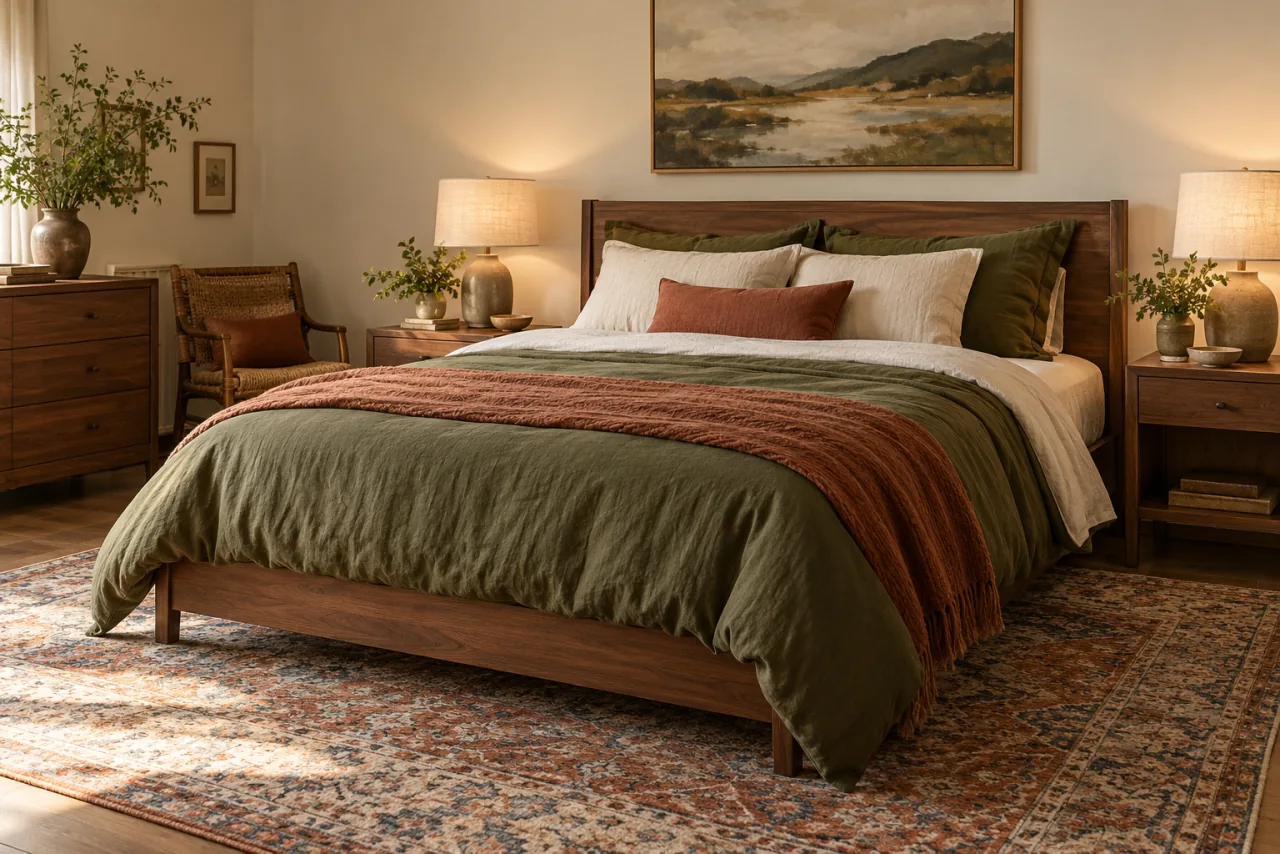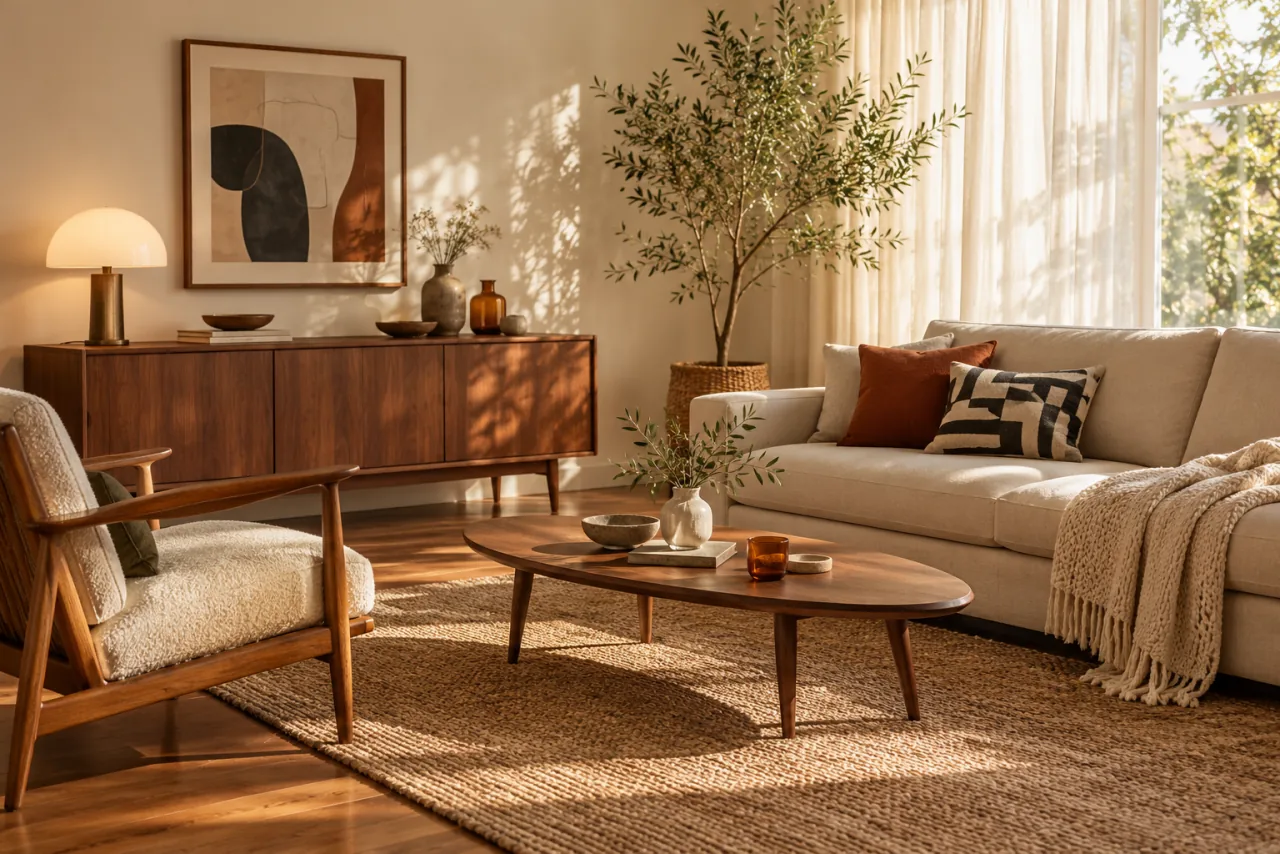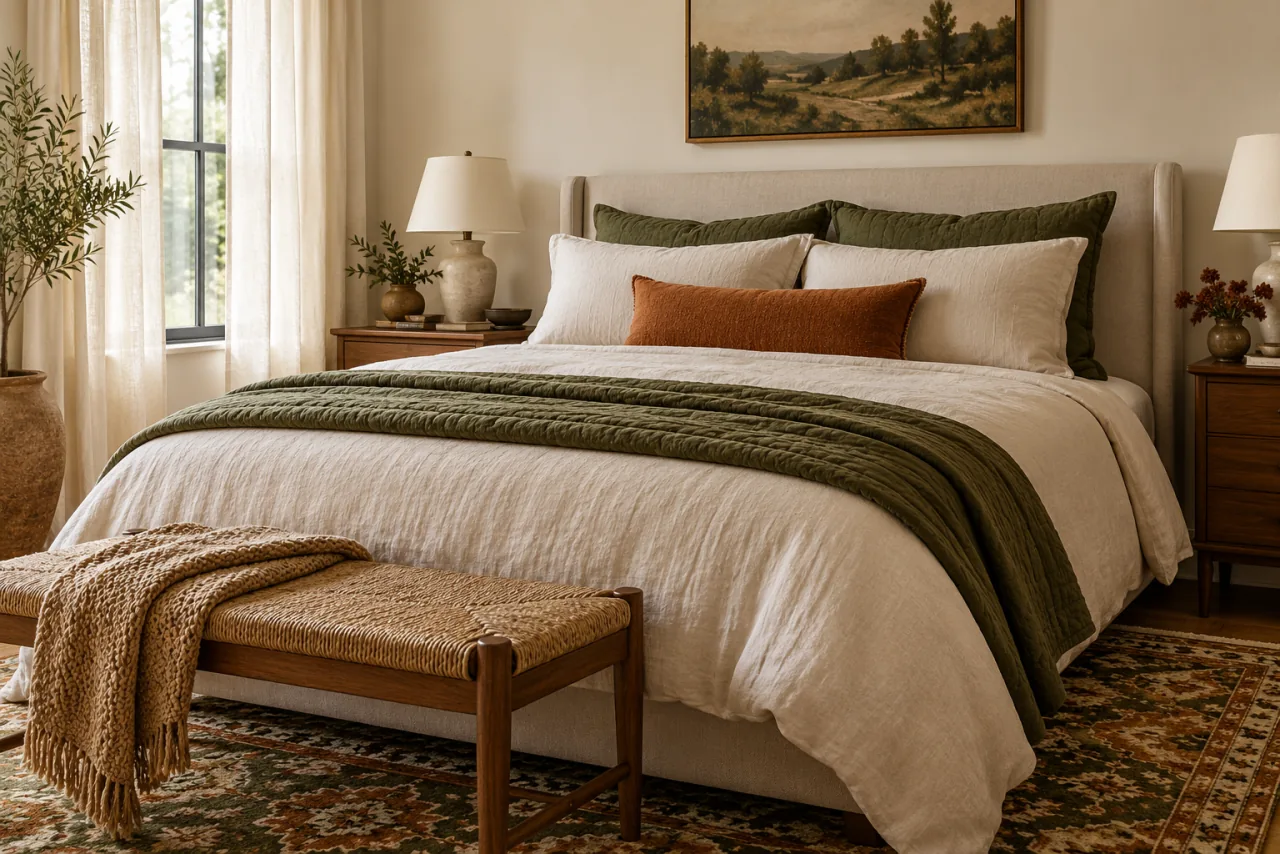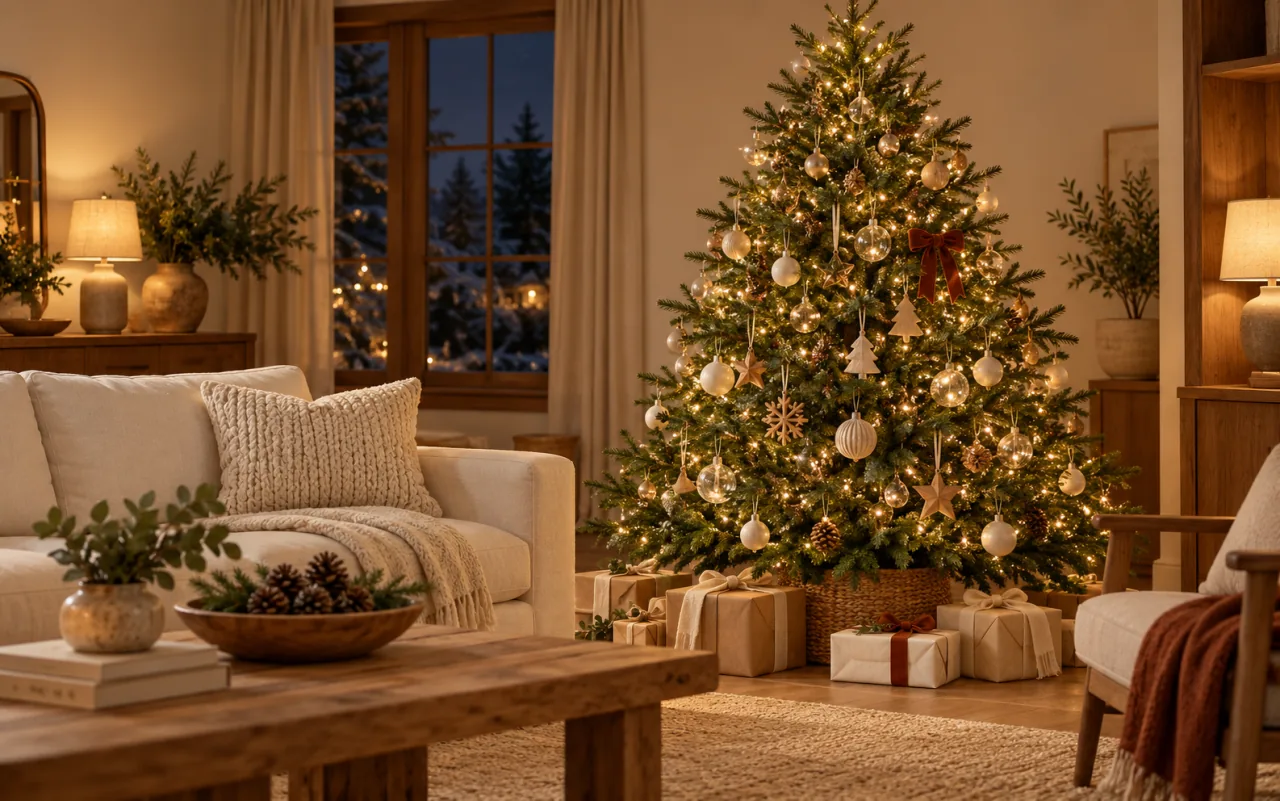
A warm neutral Christmas trades bright red and green for cream, ivory, warm wood, natural greenery and the glow of warm white lights. The result feels festive without fighting the colors you live with the rest of the year, and it is easier to pack away in January.
These ideas start with color restraint and the palette already in your rooms, then move to ornaments, one main festive zone, smaller supporting touches and lighting that is both warm and safe. The last ideas cover what to do after the season, so next year starts with an organized box instead of a tangle. Many steps use what you already own, plus a few things gathered from outside.
1. Let Your Everyday Palette Lead
Start with the colors already in the room. If you have warm wood, cream upholstery and a few earthy accents, use them as the base and add Christmas on top, rather than replacing everything with red and green.
Seasonal decor that matches the existing palette looks intentional, and you will not need to restyle pillows, rugs and art to make it work.
Try it without buying: Write down the three main colors in your living room and keep any decoration that fits them.
Watch out: Removing all your everyday color in favor of white can make a warm room look cold; keep the wood and earthy accents visible.
2. Allow One Accent Beyond the Neutrals
A calmer Christmas palette uses cream, ivory, warm wood, soft gold and natural greenery, plus one deeper accent: dark rust, cranberry-brown, olive or deep forest green. One accent adds depth; several turn back into a busy mix.
Repeat the accent in three places, such as a ribbon on the wreath, a few ornaments and one pillow.
Try it without buying: Pick the accent from something you already own, such as a throw or a vase.
Watch out: Bright red even in small amounts tends to dominate a neutral scheme; choose a muted version.
3. Choose Warm Neutral Ornaments in Mixed Finishes
Warm neutral ornaments are ivory, champagne, soft gold, clear glass, natural wood and felt or paper in oatmeal tones. Without color, finish carries interest, so mix matte, glossy, frosted and textured surfaces.
A rough split of half matte, a quarter shiny and a quarter textured keeps the tree from looking flat.
Try it without buying: Sort your existing ornaments by color and keep only the neutrals and your one accent.
Watch out: Pure white and cool silver can look icy next to warm wood; lean ivory and soft gold.
4. Hang Ornaments in Depth, Not Just on the Tips
Ornaments placed only at branch ends look flat. Hang larger ones deeper inside, near the trunk, medium ones midway, and small ones at the tips. This adds depth and catches light from inside the tree.
Group ornaments in odd numbers and spread each type around the tree.
Try it without buying: Move a few of your largest ornaments deeper into the branches and step back.
Watch out: Heavy glass ornaments can bend thin branches; hang them closer to the trunk.
5. Choose One Festive Focal Point
One festive focal point, such as the tree, the mantel or a console, carries most of the decor. Everything else in the home gets smaller touches. Concentrating effort in one place makes it look generous instead of spreading a thin layer everywhere, which matters even more when the palette is quiet.
Choose the spot you see first when you walk in. Clear everyday items from that spot so the decorations have room.
Try it without buying: Stand in the doorway and decide which spot your eye lands on first; make it the focal point.
Watch out: Two full displays in one room, such as a fully dressed tree and a full mantel, compete; keep one simpler.
6. Scale Festive Zones to the Room
Beyond the focal point, plan one or two secondary zones, such as an entry table or the dining table, and a few small touches, such as a sprig on a shelf. The zones get smaller as they move away from the main room.
For the tree, leave about 6 to 12 inches (15 to 30 cm) between the top and the ceiling, plus room for a topper.
Try it without buying: Measure your ceiling height and the corner before deciding on tree size.
Watch out: A tree that fills the corner but blocks a path or window is too big for the room.
7. Drape Natural-Looking Garland with Varied Texture
Garland in mixed greens, such as cedar, pine and eucalyptus-style leaves, looks more natural than a single uniform green. Muted or slightly frosted greens suit a warm neutral palette.
On a mantel, a straight garland about the mantel's width looks tidy; for a loose swag, allow roughly one and a half to two times the width.
Try it without buying: Lay cut branches from your yard or a garden along the mantel to test the shape.
Watch out: Keep garland away from fireplaces in use and any heat source, and avoid hooks that may damage mantel finishes.
8. Use Warm White Lights
Warm white lights glow rather than glare and make wood and cream look rich. Look for lights labeled warm white, often around 2700K; cool white and multicolor strings clash with the palette.
Use only the number of light strings and connections permitted by the manufacturer. Choose the visual density you prefer after the safety limits are met.
Try it without buying: Test your existing strings together and keep only the ones that match in color.
Watch out: Mixing warm and cool white strings is noticeable; keep one color temperature throughout.
9. Follow Indoor Light Safety Basics
Indoor light safety starts with the label. Use lights marked for indoor use and listed by a recognized testing laboratory. Before hanging, check for frayed wires, cracked sockets and loose bulbs.
Follow the package limit for how many strings can be connected, use a timer and turn lights off when leaving home or going to bed. Fire safety guidance commonly advises keeping a tree at least 3 feet (0.9 m) from heat sources.
Try it without buying: Inspect every string you own before decorating and discard any damaged ones.
Watch out: Do not run cords under rugs or through doorways, and water a real tree daily so it does not dry out.
10. Use Flameless Candles Near Greenery
Candlelight suits a warm neutral Christmas, but flames near dry greenery and paper decor are a risk. Use flameless candles in garland, on the mantel and on the tree; keep real candles to stable, nonflammable surfaces away from anything that can catch.
Cream or ivory flameless candles with a warm glow blend with the palette.
Try it without buying: Move any real candles away from garland and paper ornaments and group them on a tray.
Watch out: Never leave real candles burning unattended or within reach of children and pets.
11. Bring in Winter Texture Instead of Holiday Prints
Swap one or two pillow covers or a throw for winter textures: a cream cable knit, a wool-look plaid in muted tones or an ivory faux shearling. Texture says winter without novelty prints.
Keep the swaps small so the room still looks like your room.
Try it without buying: Bring a knit throw from the bedroom to the sofa for the season.
Watch out: Faux fur and loose knits shed or snag with pets; tighter weaves are easier.
12. Hang a Natural Wreath
A wreath of mixed greenery, dried stems or eucalyptus-style leaves fits a neutral palette better than a red bow, and it repeats the tree's greenery so the palette starts at the door. Finish it with a cream or muted accent ribbon. On a standard front door, about 36 inches (91 cm) wide, a wreath around 22 to 24 inches (56 to 61 cm) across usually looks balanced. Indoors, hang one over a mirror or on a window with ribbon.
Try it without buying: Make a small wreath shape from yard branches tied with twine.
Watch out: Over-door hangers can scratch paint or block a door from closing; check fit and, for rentals, your lease.
13. Gather Natural Materials from Outside
Pinecones, bare branches, evergreen cuttings and dried seed heads add the brown, tan and muted green that a neutral scheme needs, and they look less uniform than manufactured decor. Put branches in a tall vase, pinecones in a wooden bowl and sprigs in small jars on the secondary zones.
Try it without buying: Collect materials from your own yard or with permission from where you gather.
Watch out: Shake out insects and let materials dry before bringing them indoors, and never cut from protected areas.
14. Wrap Gifts in the Same Palette
Gifts under the tree count as decor. Kraft paper, cream paper, twine, cotton ribbon and a sprig of greenery keep the base of the tree consistent with the rest of the palette. A pile of bright, mismatched paper sits at the eye level of anyone on the sofa and can undo the calm look. Choose two papers and one ribbon and use them for every gift.
Try it without buying: Use brown paper bags or packing paper from deliveries as wrap.
Watch out: Keep wrapped gifts and paper away from lights and heat sources.
15. Pack Away by Zone
Storage after the season is easier when boxes match the zones they came from. Pack each zone, such as tree, mantel and entry, in its own labeled bin. Wrap lights around a piece of cardboard, store glass ornaments in divided boxes and wash or air out textiles before storing.
Take a quick photo of each zone before packing so setup is faster next year.
Try it without buying: Reuse shoe boxes and egg cartons for small ornaments.
Watch out: Store bins away from heat and humidity, and set aside anything you did not use this year to donate.
A Calmer Christmas Palette: Checklist
- Base the decor on your everyday palette.
- Add one muted accent beyond cream, wood, gold and greenery.
- Use neutral ornaments in mixed finishes and hang them in depth.
- Choose one festive focal point and keep other zones smaller.
- Leave 6 to 12 inches between the tree top and the ceiling.
- Use one color temperature of warm white lights.
- Check lights are indoor-rated and listed by a recognized testing laboratory.
- Use a timer and keep the tree about 3 feet from heat sources.
- Use flameless candles near greenery.
- Pack each zone in its own labeled bin.
Common Questions
How do I make neutral Christmas decor feel festive?
Use warm white lights, natural greenery and texture. Glow and greenery carry the festive feel, so color can stay quiet.
What colors go with a neutral Christmas tree?
Ivory, cream, champagne, soft gold, natural wood and greenery, plus one muted accent such as dark rust or olive.
Are LED Christmas lights safer than incandescent ones?
LEDs run cooler, but safety depends on the product. Check that lights are indoor-rated and listed by a recognized testing laboratory, and follow the package limits.
How do I keep a neutral palette from looking boring?
Mix finishes, add texture and keep one accent color. Matte, glossy and textured ornaments together look richer than one finish.